Monday, February 8, 2010

Petit Trianon: the small salon

A small but none the less charming room at the Petit Trianon is next on our tour: The small salon. The room was also used as an informal dining room and occasionally a gaming room. It lies in the northwest corner of the PT, seen in blue on the plan below, so would get excellent late afternoon light.
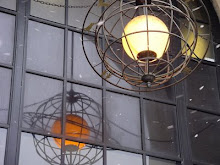
One of the reasons it is believed to have been used as a dining room is the crystal chandelier (seen from the dining room picture post linked above and also in the top picture of this post). Like I mentioned in the dining room, all other rooms in the PT have neoclassically appropriate lanterns. The room also features beautiful gilded bronze sconces which have been electrified and add soft lighting.
The room features a beautifully colorful mantelpiece of red Italian Griotte marble with a matching hearth which is featured elsewhere in the room (in the floor at the window surrounds). The red curtains play up the use of this red stone. The elevation below shows the wall as it is featured in the Boston Architectural Club Yearbook from 1913.
The moldings include an acanthus leaf crown molding which was a popular motif in neoclassical design, originating with ancient Greek architecture. I love the way the red curtains contrast the soft green painted boiseries. This red and green color pattern will follow us through the entire PT.

Friday, February 5, 2010

Petit Trianon: Dining Room

Much like it's neighbor, Versailles (which it is said to have had the first room dedicated entirely to private dining, setting the fashion), the Petit Trianon has a devoted dining room. The room is one of two with a crystal chandelier instead of the more typical lantern.
The dining room, seen here in blue, lies just above the anteroom, the first room in the set of apartments.
One of the most famous stories about the PT is that the dining room had a mechanical dining table which rose out of the floor from the kitchen below. This way, dinner guests did not need to be waited on by servants and could eat in private. Unfortunately, the table was never completed but the foundation for the device was built and can still be seen in the basement.
The dining room is set on direct axis with the French Pavilion, seen through the windows above. French houses always seem to have the view as an important end goal: whether seen through an enfilade of rooms or at the end of an allee of trees. I think this is one of the reasons that the French style of architecture remains so popular: great views make for great spaces.
The dining room features some handsome dark wood chairs. Out of all of the rooms, the dining room felt the most masculine and the most strongly neoclassical, despite the red silk curtains!
A beautiful bust of Marie Antoinette rests above the fireplace in front of a large mirror. Directly across the room, between the french doors is an identical mirror. As meals would be eaten here by candelight, magnifying the light from the precious candles was of utmost importance. I suppose that is the practical reason for the crystal and the mirrors, but the glamour factor must have been part of the decision as well! To this day, dining rooms tend to be the most glamorous room in any house.
I just couldn't get over how beautiful all of the door hardware was and even the doors themselves so I'll end here with another great door shot! Also notice the beautiful Parquet de Versailles styled floors.

Wednesday, February 3, 2010

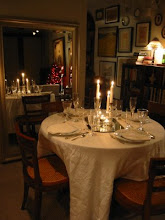
Dinner at Eight

This past weekend I had a few friends over for dinner and they were nice enough to let me interrupt the party to photograph the table settings for the weekly Tablescape Thursdays!
I took the first picture before plating the salad course - caprese salad with a nice rose wine.
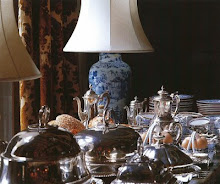
Plates are Decre Freres, Theodore Haviland Limoges, silver is freshly polished Prelude for International Silver, crystal is Waterford. Alabaster table lamp is a touch that makes it feel like an old supper club to me (from restoration hardware) and candlesticks are venetian glass from Aero in NY. I didn't get any flowers because they seem a bit much for a casual winter dinner.
For the entree course, I used my favorite cuckoo pattern dinner plates from Wedgwood. S&P shaker are mother of pearl from pottery barn. Napkins are antique irish linen from ebay (the best Christmas gift ever!). Here is what we had (ignore the lamp cord!) - roast beef with carrots, potatoes and celery -a hearty winter meal on a snowy day. For dessert (lemon pound cake with fresh whipped cream) I used the bread plates for Wedgwood 'Cuckoo', the small coffee service is antique Austrian by Ernst Wahliss, the teacups are antique Minton and the sugarbowl is cobalt jasperware by Wedgwood.
Just a close up. After all of the wine we needed some sparkling water!The tea (violet from Laduree) was served on my sideboard from my wedgwood 'cuckoo' teapot. The sterling tea strainer was NOT fun to polish after a few years of not being used! Crystal candlesticks I brought back from my trip to Paris in the fall.
Thanks for bringing the champagne! Champagne flutes by Baccarat.
The evening had some ups and downs -the foil from the champagne gave me a nasty cut which would NOT stop bleeding! The rest of the rose was the best medicine......
I love simple meals like this with very little mess (especially in a tiny apt). The huge roast beef (which i'll be eating for a week!) was accompanied by roasted carrots, celery and potatoes cooked with butter, garlic and sage. I LOVE the pattern on my potholders -the chickens always make me smile (from william sonoma)! I hope you enjoyed the meal as much as we did!

Monday, February 1, 2010

Petit Trianon: antechamber

I thought I would begin the tour of Marie Antoinette's personal rooms with her monogram. This metalwork of her initials are the doorknobs (modern) of the tour entrance to the Petit Trianon, where the gift shop is. You are then led through the service courtyard, along the rough stone corridor, through the guards chamber, up the grand staircase and arrive at the Antechamber or anteroom (follow all that without getting lost?).
This is a small room which seperates the 'public' grand stairhall from the dining room. The room continues the beautiful soft green seen in the billiards room but with more highly finished boiseries. As this building is done in the neoclassical style (and for me is the epitome of it), the boiseries are delicate: narrow stiles and rails with restrained ornamentation.
You see the room above off the grand stairhall in blue. The single window on the left faces the formal French Garden with the view culminating at the French Pavilion. The 2 windows on the bottom of the plan face the entry courtyard. The French garden was left in the more formal style put in place by Madame de Pompadour and Louis XV while the rest of the gardens were done in a more casual 'English' garden style favored at the time, as witnessed today when you visit. The room is lit by a traditional french lantern befitting the style. Under the lantern you see the top of the famous Portrait of MA, 'Marie Antoinette a la rose' by Elizabeth Vigee-Lebrun.
The portrait was hurriedly comissioned in 1783 after the first portrait of Marie Antoinette by Lebrun created a scandal for the informal way in which she was depicted. So in this portrait, she is shown in high 'court' style in full makeup and satin gown.
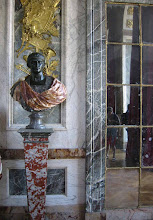
The room has 2 beautiful white marble busts on columns flanking the window with the garden view, but unfortuantely I can't remember who they are!
The doors leading into the dining room have a more ornate boiserie and again, beautiful gilded bronze hardware. Imagine carving all of this by hand!

Friday, January 29, 2010

Petit Trianon: billiard and guard's rooms.

In my second in-depth look at the Petit Trianon, we'll continue to explore the ground floor.
The billiard's room is adjacent to the grand stairhall and in the time when the trianon was first built, was intended for the male guests of Madame de Pompadour. King Louis XV himself supplied an ornate billiards table for the use of his guests: You see the room on the floorplan below in blue.

However, when Marie Antoinette was given the PT for her own private use, she had Louis XV's pool table moved up to the main level (1784). She then gave the billiards room over to the officers of the guard (who were stationed across the stairhall) with a more ordinary billiards table, probably similiar to the one found there now. A kind gesture on her part in my opinion, as it gave additional space to her guards that also occupied a prime corner room with views of the garden.
The room has a bust of Marie Antoinette on the mantel, beautiful herringbone floors and 'high' painted paneling. The jib door connects to the warming room, a sort of butler's pantry, where some of Marie Antoinette's personal china is displayed today.
This detail shot of a door shows how beautiful the gilded bronze hardware is. I especially love this shade of green paint.
Across the stairhall from the billiards room is the guards room, seen on the floor plan above in the darker green shade. It was inexpensively finished with plaster walls fauxed to look like stone and wood cabinets with fauxed-marble tops. The window and door in this room look out into the main entry court. The room would have been filled with cots, tables and chairs for the guards as they would spend most of their time here; I can only imagine how boring that would be!
On the opposite side of the guards room from the grand stairhall (seen in the light green on the floorplan) is an unfinished stone passageway. This sits under the main terrace off the dining room on the floor above. It provided passage from the service courtyard, servants lodgings and carriage house with the kitchens behind the grand stair.
Through this roughly finished space, servants could pass un-detected from the kitchens to their own dwellings without disturbing Marie Antoinette and her guests in the gardens. The guards would also use this space and could patrol who was coming in and out of the kitchens.
I love these hewn limestone walls and exposed timber beams. This unfinished roughness was the complete opposite look of the very finished spaces found elsewhere in the Petit Trianon, but one that is very popular and copied today. Join me next week when we explore the main level occupied by Marie Antoinette.

Wednesday, January 27, 2010

Petit Trianon: the grand stairhall

I'm about to start a comprehensive series of posts on the Petit Trianon utilizing drawings and my photographs; not all at once, mind you! What better place to start than the stairhall where any tour begins. Like many grand houses, the Petit Trianon is designed on a Piano Nobile layout. The ground floor is relegated to servants quarters (with the exception of the stairhall, guards room and a billiards room which all flank the courtyard to the bottom of the drawing). Above you see the ground floor plan.

The stair wraps the grand 2 story space and brings you up to the main floor above, which contains the entertaining areas as well as the primary bedroom and boudior.

This section shows the relationship a little better in blue. The main kitchen is the area on the ground floor with the large fireplace and the salon is above. The top floor were guest and servant bedrooms. I think the building is best understood here in section as it contains numerous floor and ceiling levels: not handicapped accessible!
The view above from the guards room, through the stairhall and into the billiards room shows the beautiful marble floors in the hall as well as the enfilade. The light was amazing in this space reflecting off the limestone walls, as it was within the whole house.
Stepping into the stairhall (along with the other tour members, it was crowded!) you notice the beautiful limestone staircase with gilded iron handrail. The symbols in the center portion are the monogram of Marie Antoinette. The low doorway (see the gentleman ducking) steps down into the kitchen.
The lantern crowns the space: I would love to see the room in the evening lit by it!
The doors and shutters are painted a light blue which adds some color to the neutral space.
I loved the juliet balconies and windows into the space, much like a courtyard. This one straight ahead opens into the private dressing room of the master bedroom.
A closeup of the railing where you can see the gilded monogram of Marie Antoinette.
A detail of one of the limestone brackets which decorate the room.
I'll end this first tour with some elevations, you should recognize them after the photos!
Next up, the billiards room!

Tuesday, January 26, 2010

What goes around comes around.

Just think of this as the Eames chair of the eighteenth century!

From the book by fashion illustrator Jean-Philippe Delhomme, The Cultivated Life, published by Rizzoli

Monday, January 25, 2010

All in the family

Recognize these easy chairs? No, they're not from your local thrift store! These are the chairs of Archie & Edith Bunker (Carroll O'Connor and Jean Stapleton) from the long running tv series, All in the Family (1971-1979). These items join the list of hundreds of important artifacts of American Culture at the Smithsonian's American History Museum
What I love most about this museum is the mix of low & high brow. Archie Bunker's hat and the original Kermit the Frog in the same collection as the Gunboat Philadelphia and the Star Spangled Banner. All a part of our history and something to interest everyone: Even Julia Child's kitchen! It's worth a visit (or two or three!).

Thursday, January 21, 2010

Mary E. Stewart mansion

Directly across the street from The Lindens is my favorite house in DC still in private hands, the Mary E. Stewart mansion, designed by Paul Cret.
Cret started work on the house for Stewart, the daughter of a lumber baron, in 1938 and it was completed the next year in 1939. Stewart's sister, Devore Chase, lived next door in a (slightly smaller) grand Louis XV style mansion designed by William Bottomley in 1931. The design was meant to compliment that house but transition to the more sedate Georgian style house (the Lindens) on the other side of the property. Above -Stewart's sister's house, the Devore Chase mansion. photo courtesy of robinsoneditions It currently is the dc residence of the Sultan of Oman and looks only slightly different these days - lucky man!
I think this house sums up all of the charms we Americans have with French style. All of the romance is there: creamy limestone, a tall slate roof, charming balconies and the seemingly random placement of decorative round windows and other sculptural elements. Stewart probably went to Cret with this grocery list as he was an architect born in Lyon who studied at the Ecole de Beaux Arts before moving to America.
The house is large at nearly 12,000 SF and nearly fills the lot entirely except for a small brick entry drive and the planting bed you see here along with a small side yard. As she built the house after her sister, I can't help but wonder if she wanted to slightly out-do her: nothing wrong with some sibling rivalry! Kalorama is a tight neighborhood against Rock Creek Park with very few roomy lots for yards: The grand houses tend to max out the property here in the heart of the city.
One nice feature is that the house contains 2 garages off the side street by the service entrance. While the house might look a bit odd slid up against its neighbor like this, I assure you most of the grand residences in this part of the city do the same. The house would look lovely on a large piece of land but with this much style and a primo location, you take what you can get!
I first was made aware of the property years ago when it was featured in the AIADC magazine in the summer issue of 2004 as a home of note, and it became a part of my clipping files -the article is scanned in below.

The complete drawing set for the Stewart house by Paul Cret is located at the Athenaeum library in Philedelphia along with hundreds of other drawings from his estate. As you have to pay $40 to access them online (sorry, but no thanks!!!) I'll have to make a trip up to Philly to view the documents in person someday soon!

Wednesday, January 20, 2010

The Lindens

The oldest house in DC is not the White House, and interestingly enough, did not start life out in 'the district' but rather north of Boston! The Lindens (also known as the King Hooper House) was originally built in 1754 as a Georgian styled country retreat in Danvers, Massachusetts. The house was dismantled and moved to Kalorama in 1934 by George and Miriam Morris who bought the house for $14,000 and had it moved to showcase their collection of early American furniture.
The key architect from Colonial Williamsburg's restoration, Walter Macomber, was hired to oversee the rebuilding with some revisions: noteably a concrete and steel foundation and a small addition to accomodate modern plumbing. The house retains its' original name, based on the Linden trees that lined the driveway back in Massachusetts. I love the colonial fence which surrounds the large property and the lush plantings: but where are the linden trees!
Read more about the property's history at the Washington Post or the NPS.
Photos taken with my new camera which I will review later this week -not too shabby!

Tuesday, January 19, 2010

Congratulations EEE!

The inestimatable Emily Evans Eerdmans of the eponymous blog, has recently been married and the bloggers on her blog roll have decided to throw her a wedding shower! As she is an Art Historian, I thought she would appreciate the history (as well as craftsmanship) of commissioning fine works of art from jewelers, a royal tradition.
Cartier has been accepting comissions from European royalty, maharajas and jetsetters for generations. As Emily is so entirely fabulous, she and her hubby are definitely worth of 'Le Flamboyant', a tableclock made by Cartier,Paris. The round clock is perfect for the center of a library table, so Emily won't forget a date with her husband while busy researching for one of her well-known books! The clock is formed of gold and silver and set with 1,540 diamonds, 1 ruby, 12 emeralds, 230 green tourmalines, 230 iolites, 140 pink tourmalines, 160 citrines, and much mother -of-pearl, lapis lazuli and onyx. As the name suggests, the clock is certainly bold and ornate!
Congratulations to the happy couple as they make their way home from a honeymoon in Hawaii to start married life!

Sunday, January 17, 2010

A cozy retreat

We have a long holiday weekend (in reverence of Martin Luther King) and the weather here in DC is decidely cozy: Cold and rainy. One of my favorite past-times is taking an evening walk. Everything looks so beautiful in the dark and you catch private glimpses into houses (nothing voyeuristic, I just want to see the house!). While in Paris one evening , we caught a glimpse into this cozy retreat in St. Germaine. I love the very rustic interior (those old beams!) paired with the very refined exterior of the building (that balcony and carved head!).