Wednesday, June 22, 2011

The William Penn Hotel

Since opening in 1916, the William Penn Hotel has been the cultural hub for many of Pittsburgh's more elegant social events (my parents were married here as well as having their high school proms on the upper level ballrooms).

While the hotel might be a tad bit shabby these days, I never miss a chance of having a drink in the Terrace Room off the lobby seen here, and last weekend was no exception. Elegant crystal chandeliers, great old details and wood paneling, not to mention the sense of history here, all draw me in (as did the bartender's heavy pour!).

Do you have a favorite local hotel that you haunt?

Monday, June 20, 2011

New Life, Old House

While in Pittsburgh this past weekend, I was able to tour a beautiful old house in one of my favorite neighborhoods and see the process of reinvention.

Sitting on a large lot in a mature neighborhood, the house clearly has good bones but was beginning to look a little tired. The roof is currently covered in flat clay tiles, but during the renovation slate tiles will be used (you can see the roofing work on the left hand wing).

The houses in the neighborhood all are stately but their presence belies their relatively small footprint. They may be mansions but they're not mcmansion size: rather they are human scale.

The brickwork was amazing. A watertable lies under the first floor and the windows have brick casing. This window goes into the beautiful paneled library below.

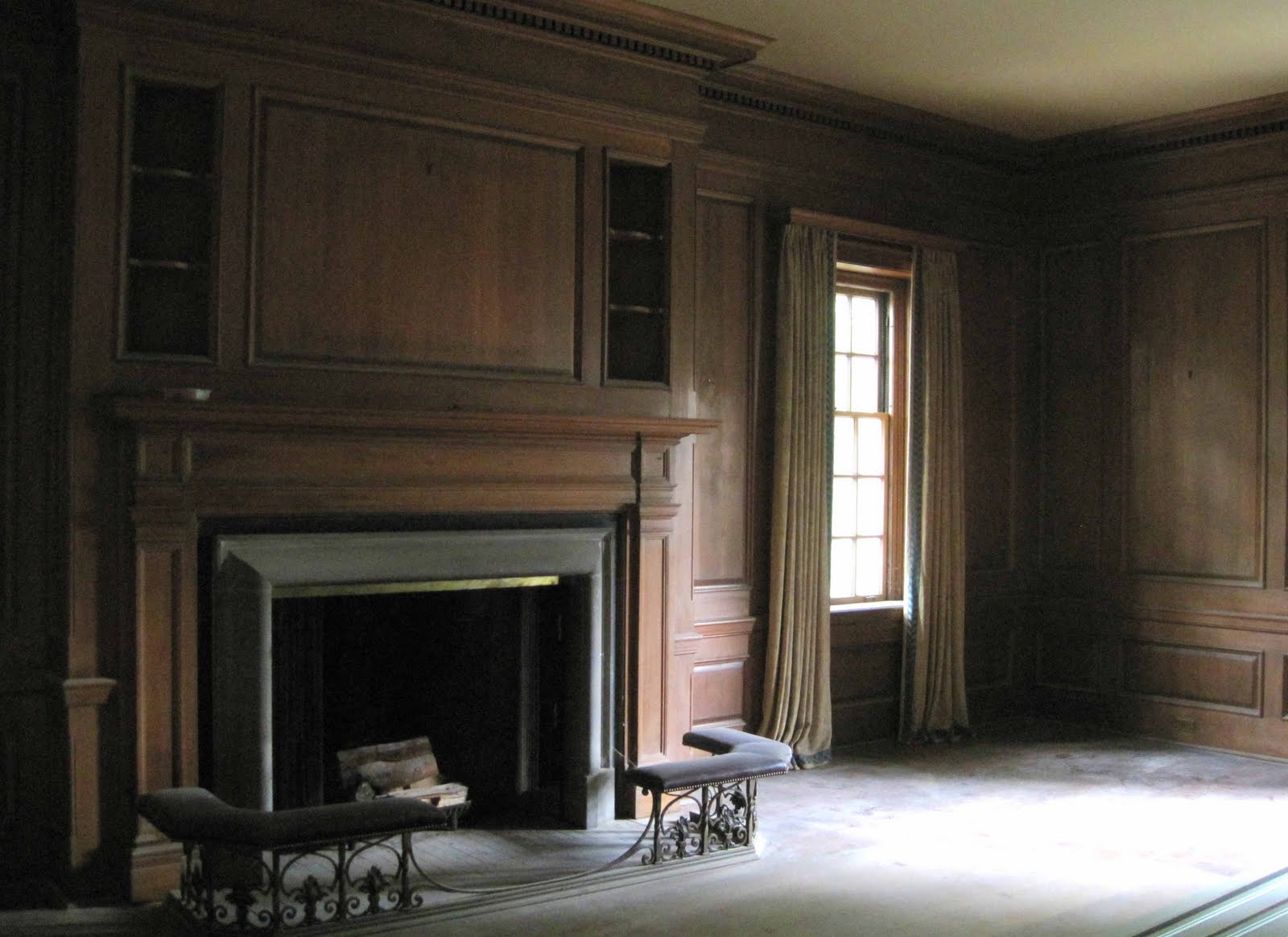
Who doesn't want a room like this in their house? It's no surprise it is the only room to go through the renovation untouched.

Double doors lead you from the entry hall into the room.

This jib, or hidden, door leads back to the butler's pantry and kitchens.

The old doors found through out the house are beautiful painted wood, raised-panel doors with a very elegant design that I haven't come across very often in my work or studies.

Many old houses don't have the insulation required for modern mechanical units so the walls throughout the house are being built-in (see the 2x4 wall construction mounted on the old plaster walls). I loved finding remnants of original wallpaper throughout the house.

This old iron light fixture was found on the ceiling of the screen porch on the back.

In the screen porch you see all of the elements coming together; beautiful old wooden screen doors, interesting wood windows, beautiful brickwork and terracotta clay tiles. In this age of the tear-down and rebuild, it is refreshing to see someone working with what they have.

Saturday, June 18, 2011

French Rococo at the Getty

While in LA, I hightailed it to the Getty to see the exhibit 'Paris: Life and Luxury'

The exhibit focuses on the home life of Parisians of the 18th century -a spectacular time and the objects on display will make your mouth water.

While photographs weren't allowed in the exhibit, I was able to take a few pictures of this French Rococo Parisian room (1730-1755) from the permanent collection (much like the period rooms at the Met). Light was so important so the boiseries were painted light colors to reflect candlelight and costly mirrors were integrated wherever possible.I'm happy to report to those naysayers, that the Getty burns the wicks of all the candles in their exhibits! If it's good enough for the Getty, it's enough reason for me!

Friday, June 17, 2011

Inside the McCormick Apartments

Sorry for the lack of posts lately; I was vacationing in LA and wasn't online as much as I would have liked. Before I bring you the highlights from that trip, I wanted to share with you the interiors of the McCormick Apartments that I talked about last week.

The building has 4 massive full floor units at 11,000 SF each and 2 smaller apartments on the first floor along with accomodations for dozens of servants.


Seen above is the typical floor plan for the 4 main units and the first two photographs show the elegant oval entry foyer.

I mentioned earlier that the building luckily contains many of the original details from when it was finished in 1915; basically everything except the bathrooms. This may be in part due to the National Trust for Historic Preservation which has taken such great care of the building since buying it from the Brookings Institute in 1977 and using it as their headquarters.The top floor apartment, famously occupied by Andrew Mellon, features numerous skylights which flood the unit with light. Above is the laylight into the foyer and one of numerous fireplace mantels.The original butler's pantries (bigger than most studio apartments) retain the original silver safes.


Many of the interior mahogany doors still have their elegant original hardware.

The long bedroom hall still has a row of 11 beautiful cedar closets with mahogany doors, useful for storage of winter clothes while the residents would leave for the summer, abandoning sweltering DC.

I loved the hidden drapery pockets in the living room.

Light is a theme throughout the apartments. The public spaces have glass french doors and transom windows allowing light to pass room to room.

The 25'x45' living room is still as elegant as ever, in this case used as the main conference room on the 2nd floor.

Here is a photograph of Andrew Mellon taken in his living room in the McCormick in 1929.

His living room was not very comfortably furnished perhaps, but I'm sure the art collection in it was amazing; his collection formed the base for the National Gallery of Art afterall, put together while living in this very apartment!

The dining room is nearly as large as the living room at 25' x 35' and opens directly into it. I love the pedimented overdoors.

Another famous tenant was Lord Duveen, the famous art dealer, who rented the apartment below the busy and aging Mellon so that he could preview different works of art in the privacy of his own apartment building. Mellon returned the favor to Duveen by purchasing every work of art he had brought: 24 paintings and 18 sculptures at the cost of $21 million (1930s dollars!).


In 1941, the state department requisitioned the apartment building (due to a lack of office space in the city) from the McCormick estate and leased it to the British Embassy. Later in 1950 the building finally left the McCormick hands and was sold to the American Council on Education. Above - plasterwork in the library.

The servants quarters are open to the main apartments but split the high 14' tall ceilings into 2 levels with an upper and lower floor with tiny bedrooms opening off a miniscule corridor.

The 2 smaller apartments on the first floor have recently been renovated and are offered to rent as the National Trust doesn't require the entire building.

I love how they have respected the historic mouldings while adding more efficient modern lighting.

Living in the McCormick wasn't cheap, as one would expect. The main apartments contained 6 bedrooms and 4 baths as well as the public spaces and would set back the renters $15,000 a year (later dropping to $12,000 a year during the great depression).

Historic photographs of the Mellon apartment from the book 'Best Addresses' by James M Goode

Saturday, June 11, 2011

Thanks Paris Hotel Boutique!

I have long been an admirer of the online retailer Paris Hotel Boutique. When Cote de Texas offered a giveaway of two of their items I jumped at the chance to register!

I was so excited when I actually won! I chose an antique silver dish marked from the Alexander Young hotel. It's so incredibly heavy, beautiful and pretty large too!

I'm happy to report that the item arrived well-packaged and extremely quick. I plan on adding the company to my list of retailers I check out on a regular basis. You never know who you are buying from in online auctions so it's nice to know this is a reputable online dealer.

For now I have the dish living on my coffee table where it really has become the star! Thanks to Joni and also to Paris Hotel Boutique!!

Wednesday, June 8, 2011

Just because it's pretty

Do we bloggers always need a reason to post pretty pictures? I for one don't think so. Sometimes we (or at least I) go to a museum simply to see something pretty and not neccesarily to learn anything. Is that too honest?

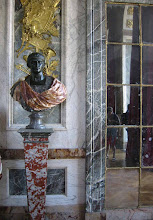
If you need another reason, it's my birthday; A little pretty is required. Shown here are some period rooms and furnishings from the Metropolitan Museum of Art. A bust of Louis XV at the age of 47 by Lemoyne and presented to his mistress, Madame de Pompadour (beat that portrait to your mistress, Congressman Weiner)


I show a lot of pictures of chandeliers on my blog I'm starting to realize. Would you believe I don't even own one myself?

Gilded lit a la duchesse (or flying tester bed) by Georges Jacob. Enjoy!

Tuesday, June 7, 2011

Shadows

I apologize for the lack of posts lately; I've had some technical difficulties and a rather full work life keeping me otherwise occupied. Before I was entirely forgotten, I wanted to just post a few photos of this marvelous malachite urn at the Metropolitan Museum of Art.

Probaly the most fascinating thing about it, other than that emerald green color, are the shadows created from the lighting. Two points to be made here: sometimes the affect of an object is more important than its existence and if you look past the obvious, sometimes you find something even more interesting. I'll be back soon!