

 Why not record your house for posterity in a memorable way like Baron Kuner did in 1760 of Memmingen, his country estate in Kunersberg -paint it on a platter. Of course, he owned his own faience pottery factory which helped! Have you done anything to record your estate?
 I have long been an admirer of the online retailer Paris Hotel Boutique. When Cote de Texas offered a giveaway of two of their items I jumped at the chance to register!
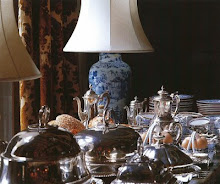
 I was so excited when I actually won! I chose an antique silver dish marked from the Alexander Young hotel. It's so incredibly heavy, beautiful and pretty large too!
 I'm happy to report that the item arrived well-packaged and extremely quick. I plan on adding the company to my list of retailers I check out on a regular basis. You never know who you are buying from in online auctions so it's nice to know this is a reputable online dealer.
 For now I have the dish living on my coffee table where it really has become the star! Thanks to Joni and also to Paris Hotel Boutique!!
 You may remember a few years ago I purchased an antique set of caned chairs and table made by Baker -see the post HERE. While the caning looked great, it wasn't very comfortable or practical and I had decided to have cushions made.
 I used Aku Merali at Marketplace Interiors in Alexandria, VA. He is a well respected upholsterer here in DC used by everyone, including the White House. He recommended attaching a pad on a wooden base to the chair instead of seperate cushions and I followed the experts advice! I am so pleased with the result and couldn't be happier. The fabric I chose is Ralph Lauren Home's English Riding Velvet in Lovat -a beautiful muted turquoise.
 After picking up the chairs on Saturday morning (thanks Mark!), I decided to host an inaugural launch and had some friends over for some fresh strawberry shortcake and champagne. I bought the Paisley Table Throw from Potterybarn which coordinates beautifully with the chair fabric. To go with the dessert theme, I used my Strawberries and Cream china by Royal Doulton and some Adam styled antique silver from Ms. Pixies.
 I am so happy with how it all turned out and even more pleased to share my small changes with you all.
 Do you hold any superstitions? I don't mean picking up pennies and avoiding black cats, this is a design blog after all! While going through some photos I took in the Metropolitan Museum of Art earlier this year, I noticed that these wall lights had the candle wicks left unburnt. I've always been taught that tapers should be charred before being left in a candlestick; not sure why, but I've always followed this rule. I know it comes from some unknown superstition but I can't seem to find what would happen if I didn't burn them! Do you follow this practice?
 The most interesting parts of any house museum, in my opinion, are the service spaces.
 Vizcaya was planned primarily around the public and entertaining rooms, which leaves only awkward leftover spaces for the numerous servants which were required in this time period. Oddly enough, the kitchen is on the 2nd floor, not in the basement (but we'll get to that later!).
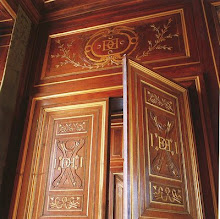
  The first of these service spaces is a cupboard off the dining room (marked passage on the plan above in blue). Functioning as a small butler's pantry, the space also worked as a hall between the dining room and tea room so had to be attractive.
 The ceiling has a gorgeous painted wood ceiling with painted wood gates hiding the service cupboard which houses china storage and wash-up sink. The gilded English china seen here has an interesting story which I'll talk about at the end of this post. PS: don't you just love these painted wood cabinets?
 Located on the opposite side of the Tea Room (seen on the plan above in green), the main butler's pantry is larger than most modern household kitchens. The room boasted the most modern of conveniences for the time period, including the electric annunciator panel above which showed where a servant was required when rung for.
 Another modern contraption was the master clock, seen behind the cabinets above, which controlled the time on 10 clocks throughout the house (much like many schools have today).
 Above you can see the painted door into the tea room. The open countertops have been converted into glassed-in display cases for the many sets of china Vizcaya posesses.
  Above is the yacht china which was in Deering's yacht moored at Vizcaya. It bears the New York Yacht Club emblem as well as his own. The china is rimmed in silver to protect it from chipping on bumpy voyages.
 The china seen here was ordered by Deering from England for his house in Chicago and was originally brought over, unfortunately, on the Titantic. The china obviously had to be remade and was shipped over a few years later (hand gilding isn't fast!)
  By this point Vizcaya had been completed so it was brought here where it remains to this day. The originally ordered china, however, still lies at the bottom of the Atlantic. No word however on whether the White Star Line covered the replacements; does anyone know? Now THATS a story!
 As blogger is being problematic with uploading photos, instead of a real post I'll share with you an adventure from my weekend. A friend from NYC who had never visited DC decided to come down for the weekend as my guest and see the sights.
 After a busy Saturday walking around the National Mall visiting the monuments and the Smithsonian museums, we decided to make a simple, filling meal at home: a salad followed by a steak, potatoes and asparagus.
 For the steak, I thought I would take a tip from Jacques Pepin and fry it in butter. BAD PLAN, Jacques! After 2 minutes my apartment was filled with so much heavy smoke that you could barely see 2 hands in front of your face, setting off my smoke detector. Regrettably, I opened my windows and then the door to my condo's hallway -which then set off the entire building's fire alarm system!
 Sirens blaring, an annoying electronic voice repeating *WARNING WARNING* every 30 SECONDS, elevators and doors disabled for 30 minutes, I then had to explain to not only about 30 of my neighbors that it was a false alarm but also to about 10 very kind (and annoyed) firemen! All said and done, after the excitement ceased, the meal was delicious. So much for a relaxing meal for two! How was your weekend?
 This past weekend, I hosted Easter dinner for six and thought I would share it with all of you via the weekly Tablescape Thursdays at Between Naps on the Porch.
 I was tired of the white tablecloths I have, so I went to Pottery Barn and got this beautiful tan paisley cloth. It has tiny specs of green in the pattern that match the green linen napkins I already had.
 I used my white sanssouci plates for the main course (roast lamb and vegetables) with some pretty antique plates by Ernst Wahliss with a red floral pattern for the salad course (waldorf salad).
 The serving pieces are an antique pattern by Minton that I rarely get to use as they're so big! I dream of having a dining room someday so I can hang that huge platter on the wall!
 I chose 2 small bunches of ranunculus on either end of the table, leaving the main course as the center of attention (family style).
 I had to have a fun party favor to embaress my guests with. These candy suckers in the shape of a bunny snout will come in handy for ransom someday as I insisted each guest had their picture taken 'wearing' them!
 I hope you enjoyed my Easter dinner tour!

 Posts
All Comments
Posts
All Comments














.JPG)