A few weekends ago I attended a wedding at a beautiful mansion along 15th street here in Washington DC. If you're not familiar with the area - it's right along Meridian Hill park: one of the hidden gems here in DC.

Now in a bustling urban residential area above U street in Columbia Heights, for years the park was overrun with drug dealers and prostitutes. Designed in 1914 by George Burnap to copy the city parks in Europe, it soon became lined with grand mansions which now house embassies and beautiful apartment buildings.

One of these mansions is now home to the
Josephine Butler Parks Center. This 18,000 SF Italian renaissance revival mansion had been home to two embassies, Hungary & Brazil. Designed in 1927 by
George Oakley Totten Jr., a prominent local architect who designed numerous embassies, it now it houses a diverse range of community groups and can be rented for private events.

What better place for a wedding than a lovely mansion facing a park! The yellow walls with white stone trim are magnificent against the greenery.

The distinctive yellow stucco makes the mansion stand out along a street of imposing buildings. The exterior has been recently renovated and really was well done.

The house still features a lot of its original ironwork which is really impressive.

A circular drive takes you to the entrance under this grand portico. The roof is a balcony facing the park.

The drive is bordered by this beautiful terra cotta guardrail - amazing details!

I love the figures on the scrolls at the bottom of the drive.

Even the backside of the scrolls have this beautiful detailing -only the black eyed susans get to enjoy these though! Lets go inside.

The building has been renovated many times but still has really great porportions and beautiful light due to the huge windows. Above is the rather utilitarian entrance which brings you to the grand stair.

The home has a piano nobile design (the main floor is what we Americans would call the 2nd story) , a typical Italian renaissance feature; all the better to enjoy views of the park. At the top of the stair is a more grand foyer with entry to the portico's balcony.

To the left is a room now used as the dining room. These main public rooms still feature the original fireplaces and mouldings and have huge french doors looking over the park. Behind those doors flanking the fireplace is a corner study which is practically a conservatory because of the amount of glass.

Here you see through the foyer into the ballroom from the dining room.

This room has all you could ever want: tall ceilings, huge windows facing a park and beautiful detailing. The distinctive yellow color from the exterior continues all throughout the interior.

The antique chandeliers are a bit under-scaled but still a nice touch. I assume they're not original.

In other rooms you can see this has been a busy, functional building, altered over the years. Walls have been moved and details stripped as needed. Here you can see a little bit of former glory above a fireplace.

In other areas you can see where new walls have been added - the crown moulding here dies into the new wall.

The servants staircase still has these original sconces. I was happy to see they're using energy efficient bulbs but wow, aren't they ugly? It was so exciting for me to explore this old mansion and the dreams of retoring it to its former glamour filled my dreams for nights to come!
 One of these mansions is now home to the Josephine Butler Parks Center. This 18,000 SF Italian renaissance revival mansion had been home to two embassies, Hungary & Brazil. Designed in 1927 by George Oakley Totten Jr., a prominent local architect who designed numerous embassies, it now it houses a diverse range of community groups and can be rented for private events.
 The distinctive yellow stucco makes the mansion stand out along a street of imposing buildings. The exterior has been recently renovated and really was well done.
 I love the figures on the scrolls at the bottom of the drive.
 This room has all you could ever want: tall ceilings, huge windows facing a park and beautiful detailing. The distinctive yellow color from the exterior continues all throughout the interior.

 Versailles, both in the age of Louis XIV and now, is a very public place. Tens of thousands of people called it home back in the age of kings and today thousands of visitors come daily. We got to witness this on a VERY crowded Sunday when we visited during Heather's and my trip to Paris as you can see below.
 Levels of security exist even outside of the Palace walls. I particularly loved these wood guard stations disguised as tents: a technique copied at palaces around Europe in the 18th century.
 Of course not all of the spaces in Versailles are as luxurious and spacious as we see in pictures: think of the hall of mirrors for example. However, many of the smaller private spaces are as luxurious as the public ones as seen in the gold & silver ceiling in the king's private chambers.

 The guards slept & ate here, right under the king. These closets flanked the staircase for their personal items.
 Of course beautiful statuary exists even here!
 A small but grand staircase leads you right up to the king's private apartment.
 At some point the wall paneling had been removed and they had 'replaced' it with faux painted panels which I really loved. What a great idea for your own home! Instant 'architecture'!
 While the king was very open to public contact, for safety reasons, as well as to hold the large numbers of visitors, anterooms flank the more important chambers. They are of course meant to impress as seen in this small room above.
 The king's waiting room is very large and filled with treasures meant to both interest and intimidate guests. The mechanical calendar seen in front of the mirror represented that the king was a very scientific and intelligent man leading the country into the future.
 The king's (Louis XVI) private study, off of the waiting room, had books paneling the walls. Louis XVI was known to have important scholars of the day visit him here as well as many hours spent alone reading a book. Even the doorways are disguised as bookshelves as seen above.
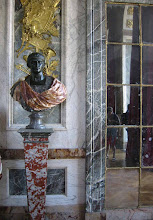
 The table in the middle of this room holds statues of many of the great learned men of the day, included among them is Voltaire.
 The king's chambers attach to the chateau through a much more grand staircase as you are lead into the public areas.
 Just a gratuitous shot of some antique mirror: Such great ambiance!
 They don't call it private Versailles for nothing, this was the toilet off the private study of Louis XIV. Watch out for splinters!


 The living room of Betsy Bloomingdale in Bel Air, California, decorated by Haines, seen here in 1959. I love his mix of antiques with modern furnishings. Thats the way to live that never goes out of style!
 Read more about the end of the struggle online :
 Marie Antoinette loved to perform. Before becoming the Dauphine of France back home in Austria, she actually took comedic acting classes to perfect the French language.
 In 1777 she asked her architect, Richard Mique to take inspiration from the auditorium at the Chateau de Choisy (built for her predecessor of the Petit Trianon, Madame de Pompadour) and build her a simple theater on the grounds of her little estate.
 The theater was completed in 1779 but the Queen stopped acting here after the death of her child in 1780 and remained in the audience.
 The entrance features a classic pediment, sculpted by DeDeschamps, supported by 2 ionic columns. I love the little randomly placed window here!
 The entrance is a very small vestibule, covered in blue silk, with a white sculpted doorway into the theater.
 Looks like the real thing though!
 The theater lies right behind the very formal part of the garden near the
  and acts as a transition into the English Gardens
 Directly across from the entrance to the theater is the English garden arbour.

 Another folly built on the grounds of the Petit Trianon for Marie Antoinette by Richard Mique & Hubert Robert is the Temple of Love.


 It sits out in the English landscape. Here it is viewed from the side of the house.
 The Petit Trianon, finally making its' debut as seen from the Temple of Love.


 Posts
Posts










.JPG)