Ever since Louis XIV moved the seat of French government to
Versailles it has been a very public place full of visitors very unlike the original hunting lodge he inherited.
You have your chance to see the chateau a little closer to home as Versailles has come to us. Until July 29, 2018 the exhibit '
Visitors to Versailles' is at the Metropolitan Museum in NYC.
I visited the exhibit back in May and while it doesn't compare with the real thing it is a great introduction to the history of the storied chateaux.
The palace, after the ransacking of the revolution, is still shockingly accurate to pre-revolutionary time (despite the touch of future generations). I spent a lovely day in Versailles last month and all of the historic images from the exhibit are instantly recognizable.
The crowds may be rather more casually dressed these days but they still come to ogle the spectacle that is Versailles.
Back in the 17th and 18th centuries your rank and dress could grant you varying degrees of access to the chateau. The gardens were open to the public but if you were well dressed you could gain entry inside and even see the king. There were ways of sorting the wheat from the chaff however.
Interior court costume rules were very strict: you were told what to wear to get into the most private spaces which only the very rich could afford. The exhibit had a few original examples of court dress which are works of art unto themselves.
The embroidery is as fine on the men's clothing as on the women's.
In addition to Paris the town of Versailles (which is charming, btw, and worth a visit) was full of seamstresses and haberdasheries that could supply you with the necessary clothing to gain access; for a price.
The exhibit had this tavern sign from 1760 showing a young man in his finery. After the long 12 mile journey from Paris, naturally visitors would want to refresh themselves and change into their court dress at places such as a tavern or hotel. Versailles is easily reached today on the RER metro but was rather more difficult to visit in the 18th century for the common man.
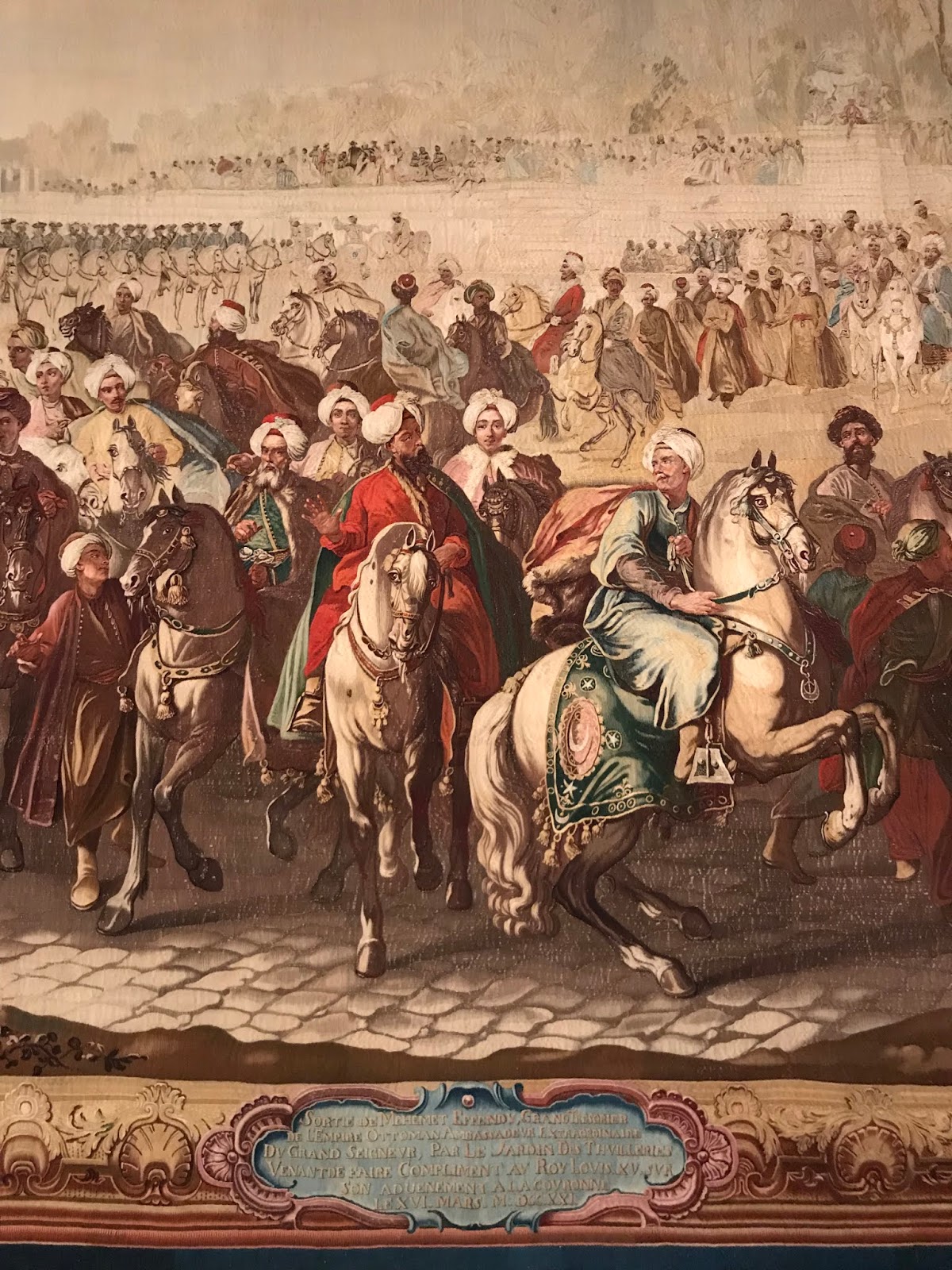
A large part of the exhibit deals with more official visits however: those from ambassadors of foreign countries.
Many came bearing costly gifts in addition to their large entourages and townspeople would line up to see the spectacle. The king was trying to impress the visitors with his chateau so the ambassadors had to really try hard to impress the king in return.
This bejeweled
Ottoman powder flask is one of many impressive gifts on display.
Under Louis XIV ambassadors had their own staircase designed by Louis le Vau in the late 17th century, which this amazing model depicts (built in 1958) .
Sadly the staircase was removed in 1752 leaving ambassadors to enter the palace by other more ordinary means.
Inside the palace the best of France was on display. These large urns and an Aubusson carpet above are some examples shown in an interesting interpretation of the hall of mirrors.
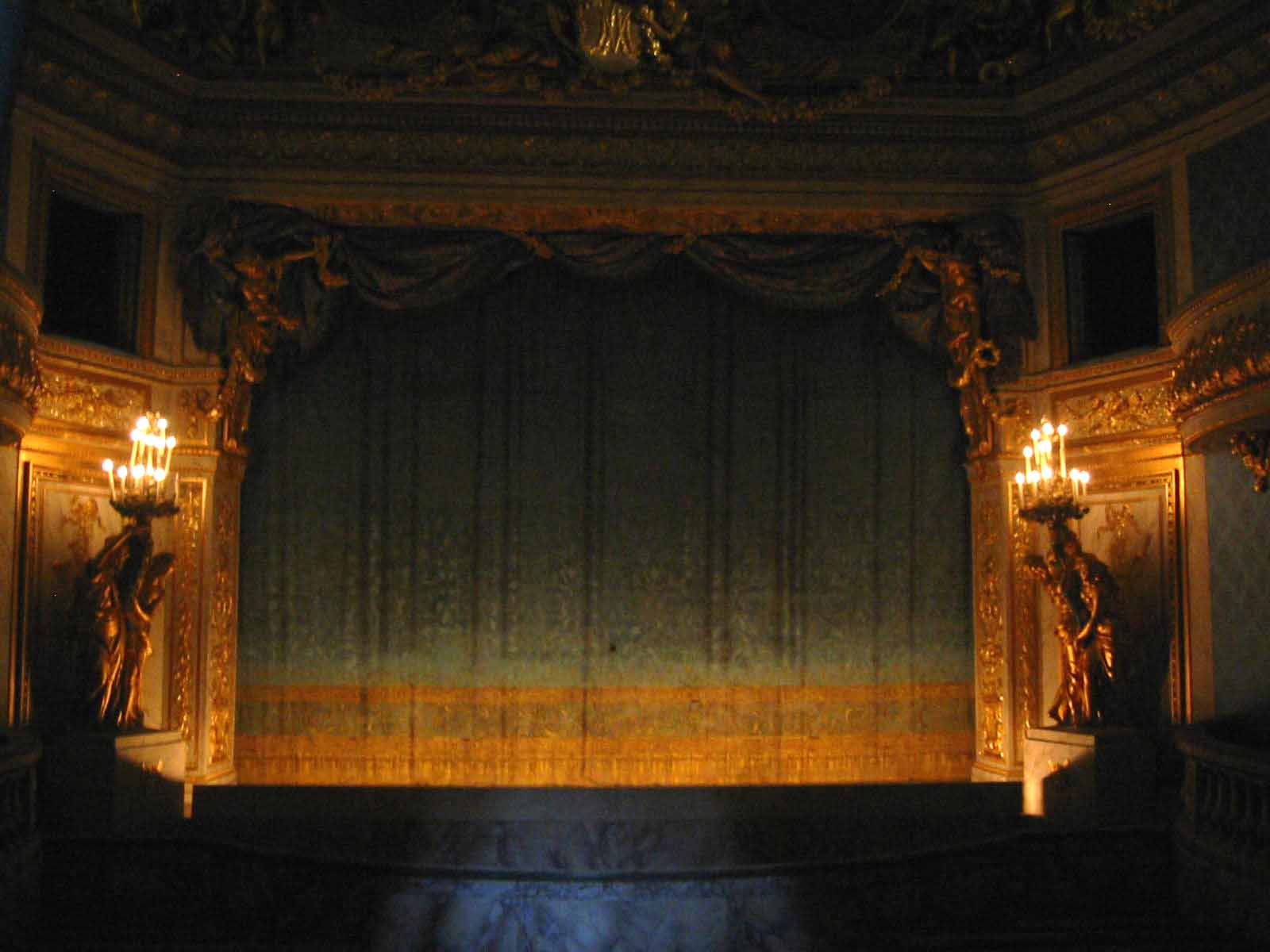
Visitors were entertained in other areas of Versailles as well. Marie Antoinette made full use of the gardens of her Petit Trianon to host select groups of friends. There were lovely night-time paintings on loan for the exhibit commissioned by the queen to commemorate certain visits. Seen above are the Rock and Belvedere lit for a party, painted by Claude Louis Chatelet for the queen in honor of the visit of her brother Emperor Joseph II on August 3, 1781.
The rock and the belvedere are instantly recognizable today thanks to loving restorations -seen above last month during my visit.
The other nighttime painting in the exhibit is of the Temple of Love. The painting by Hubert Robert commemorates a fireworks display for the visit of Paul and Maria Feodorovna of Russia in 1782. These paintings were definitely my favorite items in the exhibit.
Above you can see the temple of love, just visible beyond the Petit Trianon, and easily viewed from Marie Antoinette's bedroom.
Also on display, although they came from just over the river from a museum in the Bronx, are some personal items of furniture commissioned by Queen Marie Antoinette.
Above are an amazing armchair made for the queen by Jacques Gondouin and a commode by Jean Henri Riesener.
The exhibit is pretty great if you've never been to the chateau in person, but nothing can ever prepare you for the shear (exhausting) scale of the palace and gardens.
I had visited the palace and the Trianons a few times in the past so on this past visit devoted my day to the gardens and was graced with perfect weather. Notice the scale of the few other people visiting the orangery above....those doors must be over 20'-0" tall!! No drawings or photographs can prepare you for that.
The immense scale of the gardens meant that most areas aren't perhaps as lovingly tended as others, but impressive none the less if only for their size. They aren't kidding when they tell you to wear comfortable shoes; you will be exhausted!
June is a great time to visit: Roses and orange trees are in bloom and hopefully you'll have as lovely weather as we did.
Here is the Colonnade from 1685 designed by Mansart. 32 marble columns and pilasters surround the immense space which was frequently used by the king for his daily walks and outdoor musical entertainments.
If a visit to Versailles is not in your immediate future I urge you to visit '
Visitors to Versailles' at the Met in New York and take in a little French magnificence closer to home!




 You may recall my visit nearly 2 years ago and my many many posts (and pictures!) of the chateau so I won't deluge you now but you can of course reference them through my blog search feature in the toolbar.
 A leisurely delicious lunch was spent at Angelina's in Versailles which included some of their famously decadent desserts. The hot chocolate IS as good as they claim and the Mont Blanc could feed a family of four for at least a week (if that family lived on sugar alone). Sinful; as was the fois gras which was probably the most delicious thing I've eaten in my entire life.
 Of course, no visit to Versailles is complete without a visit to the Petit Trianon, forever associated with Marie Antoinette whose bed at Versailles you see above.


 Arguably, the most important room to the mistress of a 18th century house is her boudoir. The derivation of the word is from the French word Bouder or 'to pout' . Here she can unwind in her own personal space, far from the worries of her household (simliar to a 'mancave' today I think)! Technically, the boudoir is a private sitting or dressing area off of a bedroom. In the case of the Petit Trianon, this little room has some big impact, impressive features!
 The room lies in the northeast corner of the first floor, in between the Salon (to which there is a jib or secret door) and Marie Antoinette's bedroom, marked in blue above.
 Many of the details match that of the adjacent bedroom, including the pale blue color scheme. However, as this is a less public space, the boiseries are even simpler than in the bedroom. They saved the most showy spaces for the public, much as we do today in our own homes. The level of ornateness often would correspond to the level of privacy held by the space.
 Above you can see the mirror half covering the window. While in the full height position, the mirrors act as part of the paneling and you can't even tell they are covering anything. A daybed (for naps or lounging) as well as a tea table with comfortable chairs furnish the room.
 I wish I had a better photograph of the fireplace than the one above, but the drawing below shows it in detail. Beautiful white marble, delicate carvings and the diminutive scale emphasize the femininity of the small space.
 Here you can see the mirror from above which is half covering the above window and starting to be visable in the servants quarters.


 Posts
Posts







.JPG)