Friday, September 5, 2014

Inside the Villa del Balbianello

Nestled into the hills surrounding Lake Como is the Villa del Balbianello which is open to the public. On his recent visit my penpal thankfully shared these photos with us!
Last inhabited by explorer Guido Monzino, the villa is left as if he had just packed up on one of his adventures. Decorated in classical mid-century splendor there is much inside to inspire today's decorators.
Before going inside lets first lets explore the grounds of the villa as the setting is really more spectacular than the architecture. Built in 1787 as a Franciscan Monastery, the villa shortly thereafter became a family home.
The Villa and gardens were restored in the early 20th century by an American businessman, Butler Ames, who used it as his vacation home.
The views of the lake and surrounding hillsides are stunning. The gardens are kept simple to allow the view to take precedence.
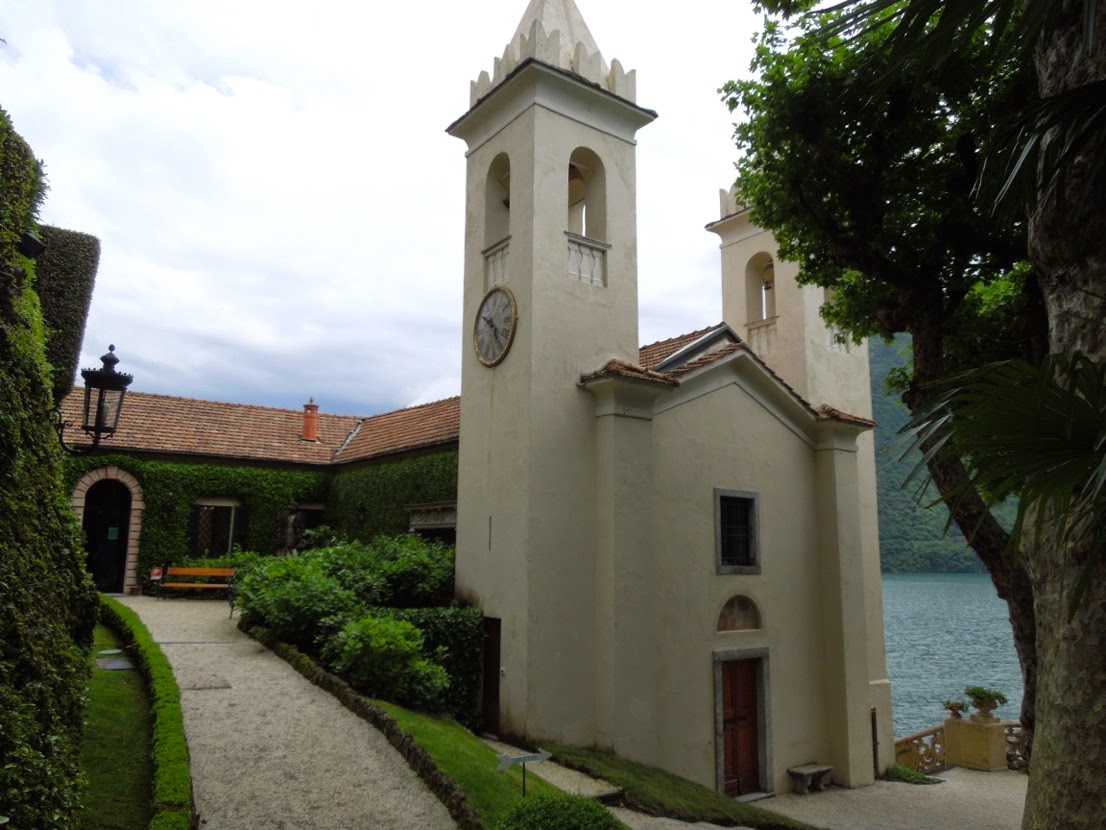
Above you can see the original chapel with clocktower.
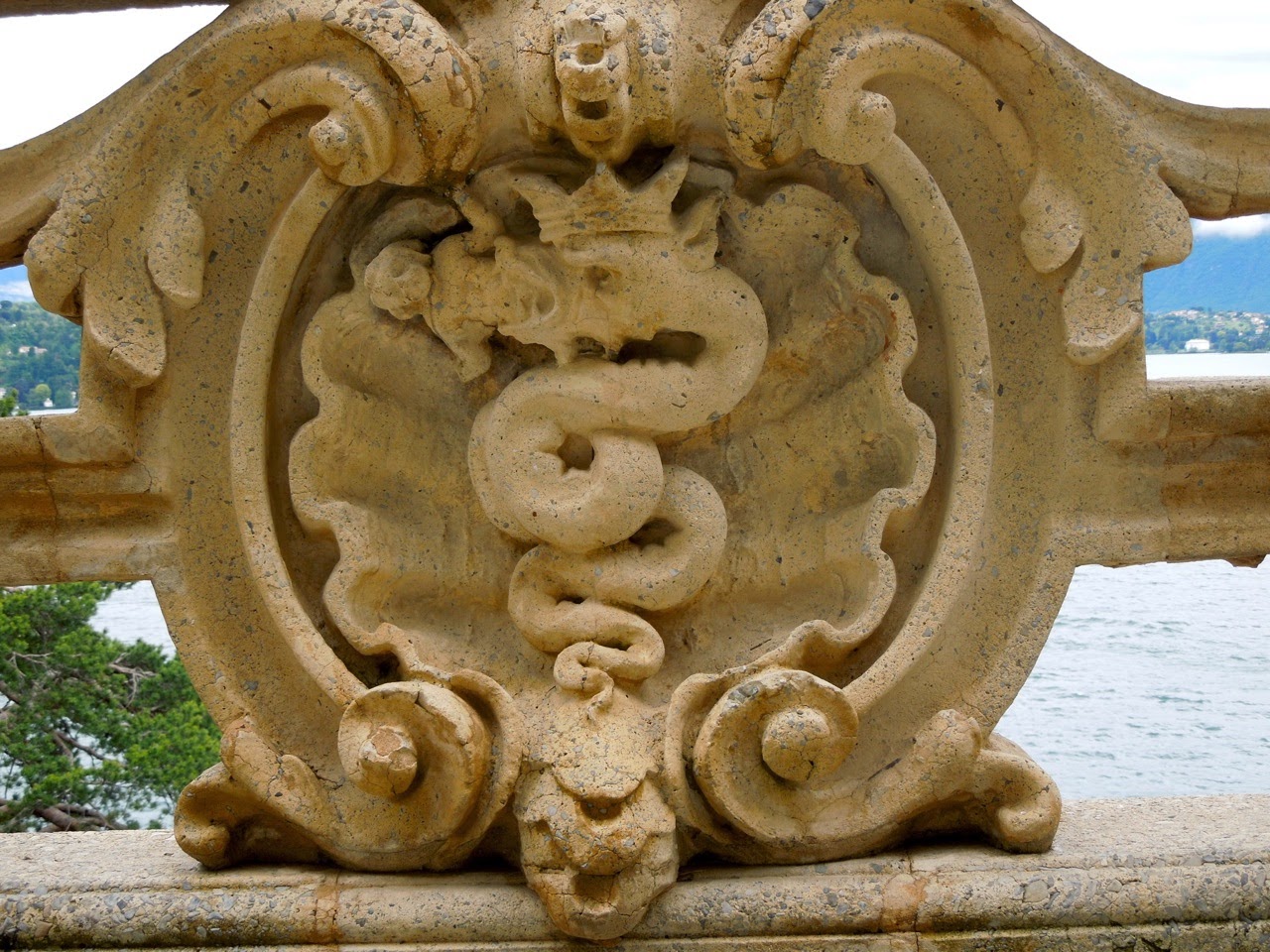
The carved stonework is intricate and fanciful.
 How would you like to wake up to this view everyday? Sign me up!
Inside the elegantly muted interiors leave the spectacular views to become the focal point.
I love these soft boiseries in the main salon. Notice the chandelier is not electrified.
 Looking the other direction the views of the lake are probably amazing.
I wish I had one of these 2 story paneled libraries in my own house! The chandelier is more practically electrified.
 This paneled sitting room operates as a sort of treasury or collector's cabinet.
 The touches of green throughout the house connect the interiors of the villa to the gardens.
 I love the very elegant sitting room above.
The dining room looks as if it could hold quite the large dinner party, perfect for lots of weekend guests. The dreary red carpet 'runway' to protect the floor finishes really ruins the effect.
The velvet upholstered furniture throughout the house is all really beautiful and not dated at all. The chinoiserie secretary is probably coveted by many!
 Notice the very (now) trendy printed curtains in the breakfast room.
 The villa appears to be full of many dining room or perhaps this is a study off the library?
 The kitchen remains efficient and practically simple but notice the stylish lantern fixture.
The sumptuous bedrooms again feature elegant candle-lit chandeliers. I'm assuming these would never or rarely be lit!
 The marble bathrooms are again beautifully detailed.
I think something is really charming about guest bedrooms with pairs of twin beds; I'll file this away for inspiration.
Monzino loved the Villa del Balbianello so much that he is even buried on the property. I can see why; I've added the Villa of my (long) bucket list of places to visit!

Thursday, September 4, 2014

Arco della Pace, Milan

Recently my Austrlian Penpal sent me photos from his trip to Milan, Italy, including photos of the Porta Sempione. The centerpiece of this city gate is the Arco della Pace, or Arch of Peace, designed by Luigi Cagnola in the early 19th century.
The arch replaced an ancient Roman wall and gateway which were called Jupiter's gate or Porta Giovia. The significance behind the arch remains a mystery. It was either built in wood in 1806 for the marriage of Eugene Beauharnais with a Bavarian princess and later recreated in more permanent marble, or was designed for Napolean in 1807. Either way the arch wasn't completed until 1838 for Emperor Francis II, 5 years after Cagnola's death. Flanking the arch are exquisite neoclassical customs houses.
 Other than the iconic Parisian Arc de Triomphe it remains the largest structure of its kind.
 The construction of the sculpture reliefs are not only marble but also wood, bronze, and stucco.
If you find yourself in Milan, take a break from shopping to check out the Aro della Pace!

Tuesday, September 2, 2014

Pittsburgh from above

As long time readers of this blog know that while I've called Washington, DC home for nearly 13 years I'm originally from Pittsburgh, Pennsylvania; home to Heinz ketchup, robber barons, Andy Warhol, and Mr. Rogers.
This past labor day weekend I had the chance to play tour-guide for a few friends on a quick trip to the city which is thankfully only a 4 hour drive from DC.  Seeing your 'home' from a visitor's viewpoint is always eye-opening and left me with a new-found appreciation for the city.
After a day spent at Kennywood (a historic and very pretty amusement park set amid gardens) we visited downtown Pittsburgh from above. No not from a helicopter but on one of the 2 remaining funicular's or "inclines" which lead one from the river's edge up to the neighborhood of Mt. Washington overlooking the city. I believe at one time there were 13 of these cars operating along the river, some of which could even carry cars!
We had typical "Pittsburgh weather" as I call it - overcast and drizzly - but the sun was able to breakout a few times to enjoy the view.
If you ever find yourself in Pittsburgh treat yourself to a round trip on one of the 'inclines'!

Friday, August 29, 2014

Playful architectural trimwork

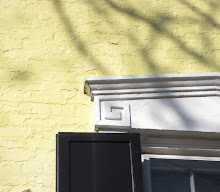
On Cape Cod last month I noticed this charming cottage while on a bike ride and had to stop to take pictures like any self respecting architect. What I really appreciated was the playful trimwork and beautiful colors used; vintage yet fresh.
Oddly enough this house is only a block away from another I featured a few years ago, Carpenter's Gothic and has the same beachy charm.
I won't comment on the fake roofing material but the natural wood shingles and shades of green trim have my vote! What do you think?

Thursday, August 28, 2014

A baroque masterpiece: Fulda Cathedral

Leaving the playful rococo style seen in the last post, Amalienburg, we now visit Fulda, Germany, to tour the baroque masterpiece of Fulda Cathedral. The baroque style was a direct response to the rococo and was based on more serious Romanesque architecture. The ornament is restrained with lots of 'blank space' for contrast to let the eye rest.
My Australian penpal on his most recent European adventure had little to say about the cathedral, I think in part because this restraint in comparison to the over-the-top'ness of the profuse German rococo can be somewhat underwhelming. This architectural purity of the baroque style appeals to me personally though.
The Cathedral was designed in 1700 by the German baroque architect Johann Dientzenhofer after a visit to Rome.  Dientzenhofer was clearly inspired by St Peter's Basilica, a masterpiece from the Renaissance which every great architect and artist had worked on: Bernini, Michelangelo, Maderno, and Bramante to name a few. Who wouldn't be inspired?
 As with most churches, light is everything.
I think it's interesting to note that unlike both earlier and later churches, stained glass wasn't a feature -here the light, space, and the architecture itself are left to speak.
One of the most noted features of this Cathedral is the world famous pipe organ which you can read about here if you're interested. Personally I always think of music when I imagine the baroque period so having a masterful pipe organ in this church makes sense!
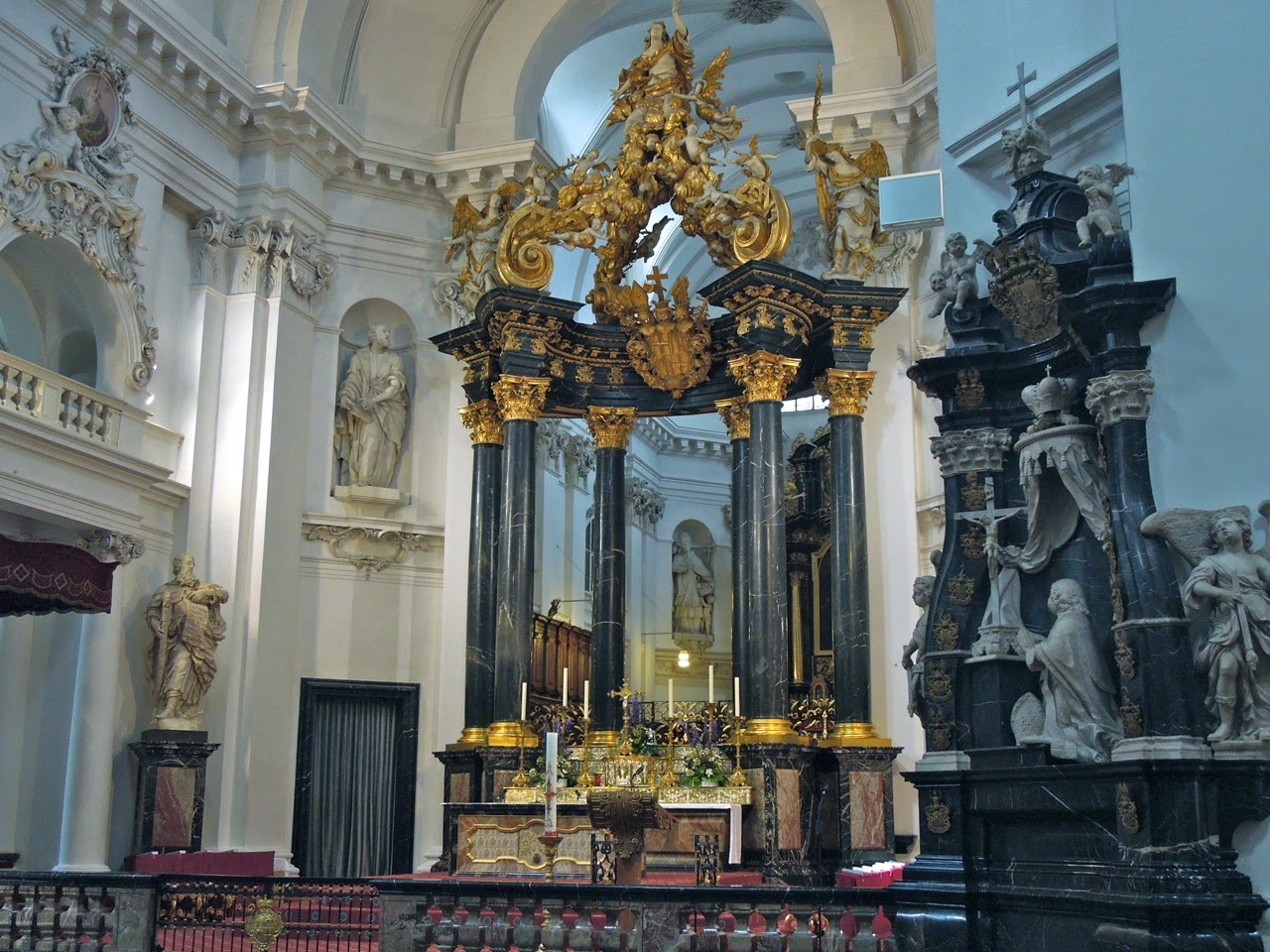
It may be baroque but the rococo qualities are still seen in the sculptures.
What I love about a baroque church is that the ornament is purposeful -one knows where to look during a service and also knows what is important. Everything isn't ornamented equally, rather the pulpit and the alter are given pride of place.
I hope you enjoyed this little architectural history lesson and visit to Fulda Cathedral. I've added Fulda to my travel wish list!
As always click on the images to view larger

Tuesday, August 26, 2014

Amalienburg - heaven at Nymphenburg palace

Long time readers may remember a brief post I wrote in 2009 on Falkenlust Schloss which was based on a hunting lodge built at the palace grounds of Nymphenburg, Germany. That hunting lodge is Amalienburg which I'll discuss here.
Described as heaven on earth by my Australian penpal who provided me with these pictures, the rococo palace is Nymphenburg's answer to the Petit Trianon at Versailles (although built 20 years prior in 1739). This small building was built for the king's wife, Maria Amalia, as a hunting lodge or escape from the main palace or schloss.
 The pink and white stucco exterior is perfectly symmetrical naturally.
The main salon is mirrored and silver-leafed to within an inch of its life while the rest of the paneling is painted a dreamy light blue.
The reflection of light from the french doors in the mirrors plus the light color helps blur the boundary of the space - imagine it on a sunny day!
 Even if you don't like rococo I think you'll appreciate the workmanship and fine details.
The carved woodwork features women relaxing in nature with all manner of plants, hunting dogs, and birds.
 The furniture is as magnificent as the wall detailing.
The bedroom is no simple place to rest ones' head. The portraits flanking the bed are of Maria Amalia and her husband Karl Albrecht who commissioned the structure.
 Would you ever think yellow silk, and silver and yellow painted wood could be so pretty?
The adjacent 'hunting room' functions as a picture salon with paintings by Peter Jakob Horemans showing the couple at court hunts and functions; sort of an 18th century version of a den covered with family photographs!
 Again the furniture perfectly matches the wall decorations.
The most charming rooms feature hand painted linen wall-coverings in chinoiserie style. Below the room is called the 'pheasant room' and you can see why with the animal so prominently featured.
A closeup of this wallcovering reveals how playful and modern the lines seem!
The 'dog and gun room' features a similar linen wallcovering in blue and white -even more blatantly chinoiserie in style.
 Dogs slept beneath built-in gun storage in this charming space; quite the fancy kennel!
Even the kitchen was not spared the over-the-top decoration lavished on the rest of the palace. Delft tiles were used in profusion covering every surface including the stove.
 These tiles feature birds and flowers, certainly an inspiration to Howard Slatkin in his own kitchen!
As I mentioned I realize rococo is not everyone's favorite but the attention to detail and workmanship are incredible and should be inspiring to all designers!