Thursday, May 22, 2014

Architectural Models from Chisel & Mouse - now in miniature AND Frank Lloyd Wright

I recently found out some very exciting shopping news that will have many of you reaching for your wallets: One of my favorite companies, Chisel & Mouse that produces architectural models, has expanded their line to include not only miniature models but also projects by Frank Lloyd Wright!
I was surprised to arrive home last week and find a large box from sponsor Chisel & Mouse with 4 samples of their delightful and now miniature models.  All four are of well known Frank Lloyd Wright projects here within the United States.
The first I'm showing here in 4 different locations throughout my apartment is the V.C. Morris Gift Shop in San Francisco (that I'm very excited to be able to visit while on vacation in California next week!). Expanding on their idea now that many of their models can be wall mounted (as shown above) all of these include a discrete hanging spot on the back for easy display.
The wide base also allows them to sit on a mantel, bookshelf, nestled in a tablescape, desktop, or wherever you choose.
 I think their best seller will probably be this highly detailed model of the NYC Guggenheim Museum.
One of the most impressive projects by Frank Lloyd Wright is his Unity Temple in Oak Park, IL which I visited while in college.  Here you see it resting on my bookshelf where all 4 models have ended up -an impressive collection.
I think these miniature models make the perfect host /hostess gift and just in time for summer houseguest season!  Check out these and other models on their website: Chisel & Mouse. Tell them Architect Design sent you and receive a 10% discount with code "arcdesign"

Tuesday, May 20, 2014

Lutyen's British Embassy public spaces

The public spaces of Lutyen's British Embassy exemplify the British Country House look; grand, luxurious with an aire of informality, and above all Classical, albeit with a twist.
After ascending the Main stair one is confronted with a long corridor that creates the spine of the house. This axis is meant to impress the visitor, leading one to believe that the house is much larger than it actually is, while also providing ample room to entertain.
One can follow this strict axis in the floorplan above.  Much in the Beaux Arts mode, the initial spaces are where no expense is spared and the details are ravishing.
These plaster capitals, moulding, and scagliola columns would not escape the notice of the most ardent non-aesthete.
The ballroom is not hidden behind doors but rather creates a cross-axis with the corridor. Notice the Warhol portrait of Queen Elizabeth II above the mantel. The mirrors with mounted crystal sconces were my favorite part of the room. Original to the space they had been removed for decades before a previous ambassador had them re-installed.
 The level of detail found in these 85 year old plaster mouldings is impressive; no over-painting regimen here!
After the ballroom one approaches the large corner drawing room, with multiple seating groups, which faces the beautiful lawn and gardens.
 As can be expected in a house with this many large windows the quality of light is beautiful.
Opposite from the drawing room is the dining room. Again the corner location makes for the best use of light even with the opulent curtains.
These crystal girandoles flanking the mantel were show-stoppers. The mantel had been painted gray until one day a painter noticed that it was made of an orange scagliola;  the paint was judiciously removed from the columns and direct fire surround for contrast.
My favorite shot I took in the house, and which sums up the entire British attitude towards such grandeur, was this table lamp in the dining room slightly askew;  Modest to a fault.
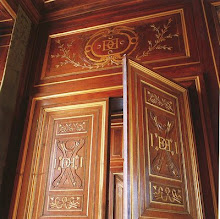
While I took hundreds of photos I have to leave some of the house a mystery so you check out the amazing book which was the purpose for my tour: The Architecture of Diplomacy: The British Ambassador's Residence in Washington. Above and in the first photo of this post you see images of the ambassador's private study which artfully bridges what was once the connection between the residence and the embassy.
No Englishman's study would be complete without a bar: this one complete with a portrait of Field Marshal Montgomery, expertly painted by President Eisenhower in 1952. And not to fret, while this may be the only general overview I'll post on the interior of the house (really, get the book as my images could NEVER compare), I still have stunning details to bring you from Lutyen's American Masterpiece: The British Embassy.

Wednesday, May 14, 2014

John Russell Pope tour and an upcoming ICAA event

I recently had the honor to host a lunch time tour of the John Russell Pope designed National Gallery of Art for the Mid-Atlantic branch of the ICAA of which I sit on the board.
Probably my favorite public building in a city of favorites, this classical gem was designed by architect John Russell Pope for Andrew W. Mellon. Mellon (basically and in short) gifted the building and the basis of its collection to the nation. In an odd twist of fate both Mellon and Pope passed away in August,1937 before the Galleries' dedication in 1941.
Clad in Tennessee pink marble the Neoclassical structure harkens the growing trend towards modernism while still looking to the past, as does much of its' collection.
Below you can see some early sketches by Pope which show the partee or basic plan as well as the massing of the building.
Largely based on Rome's Pantheon with wings housing the galleries, the structure incorporated the latest technology of the time which has held up remarkably well considering the wear and tear the building receives on a daily basis (including a recent earthquake)!
The central rotunda is my favorite space in the museum and possibly the city. The columns surrounding the central fountain are solid marble (quite the engineering feat getting those into place) which visually support a large coffered dome. While appearing to be the same stone as the rest of the interior, the dome is actually composed of plaster with a steel frame.
Indeed the entire structure is concrete and steel based with a very (modern) veneer of marble. It hides his secret well.
On either side of the rotunda are 2 skylit sculpture courts. As throughout the museum most spaces on the piano nobile are daylit by large skylights.
 The building itself is an encyclopedia on classical detailing.
I love this bronze lantern in one of the vestibules -notice the Greek key and architectural motifs.
The openings in the galleries themselves are clad in different materials -here in Italian travertine with silk damask walls (dating to the 1980s)
Seen above the current chief architect for the museum, Susan Wertheim, talks to the group about the Pantheon influence in front of Panini's painting, Interior of the Pantheon.
Speaking of classical detailing the ICAA has an upcoming lecture by Phillip James Dodd centered on his new book The Art of Classical Details on Thursday, May 22nd - a fascinating lecture not to be missed!
Information and tickets to the lecture can be purchased from the website; look towards the bottom of the events page linked HERE. Hope to see you there!

Tuesday, May 13, 2014

Lutyen's British Embassy: Main Stair

The main staircase at the British Embassy was designed by Lutyens to awe all visitors and make a grand statement. The entrance to the embassy is somewhat discreet.
One arrives underneath a classical porte cochere in the center of the complex (underneath D on the plan above) and into the main stairhall; the residence is a piano nobile design which cleverly aids the hilly topography - but we'll get into that later.
Symmetry and classical design reign on the exterior; a rather quiet facade gradually gives way to grandeur as one enters the residence.
Many of the light fixtures throughout were custom designed - the fluorescent light bulbs are really unfortunate but do not hurt the fundamental beauty of the lantern.
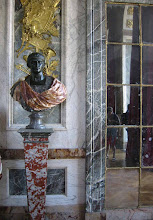
 Upon entering through french doors directly to one's left is a bust of the architect, Edwin Lutyens.
 Light pours into the lower level from windows above inviting one up. Further emphasizing this ascent are the walls which turn from heavy Indiana limestone to a lighter plaster.
 I loved the cascade of the lower risers which leads one to a short landing and the cloak rooms.
The most impressive detail of the space is the railing itself. Below is a sketch by Lutyens from early on in the design in 1925.
As you can see it didn't change much. This motif graces the endpapers of the new book on the embassy as well; The Architecture of Diplomacy.
 I love the furnished landings and I'll again point out the print gallery walls as well, installed in 2012.
Symmetry is key in the stair hall as throughout the residence. The interior window below to the right opens into an interior room: the morning room. Lutyens commonly designed such interior windows into his residential projects; supposedly so children could watch the festivities during parties!  A false mirrored window stands opposite the landing to attain this perfect symmetry.
 The placement of these ginger jars is perfection.
The ladies cloak room off the stairhall features Fornasetti's very stylish 'Teatro' wallpaper -manufactured by a very British company naturally, Cole & Son. I loved these lanterns which flanked the opening.
The entry to the public spaces of the residence feature ornate plaster-work as well as lovely urns on pedestals.
 A closeup of the plaster work reveals native flowers with classical figures.
Join me in following posts for more on the public spaces of the British Embassy.