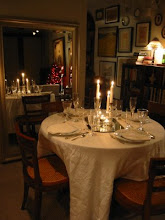
It's spelling bee time at Grey Gardens; Stay warm, everyone!
Saturday, January 17, 2009


Friday, January 16, 2009
Belmont Mansion
 The Belmont mansion, now home to the Order of the Eastern Star's International Temple, is located on an unusual triangular piece of land at 1618 New Hampshire Avenue here in the Dupont circle neighborhood of DC. I've always been fascinated by this building because of it's unusual footprint.
  a photograph from when the mansion was completed in 1909
 the mansion seen in the 1920s, behind an old firebell
The mansion was built in the Beaux arts style for Perry Belmont by the French architect Ernest Sanson who did the most grand mansions in France of the time period. Horace Trumbauer was the state side representative who was also the architect of the Elms in Newport, RI that I blogged about last year (you can read the post HERE, it is my favorite mansion in Newport).
 the gated entry today
 a side view along 18th street
 one of the rear rounded corners
The odd shaped lot was $90,000 (a lot for land alone back then!) and the house cost $1.5 MILLION to build and was completed in 1909. The interiors are extremely ornate to this day, so I'm not really surprised at the cost. The home was the headquarters for this past year's Dupont Circle house tour so I was able to see some of the interiors.
 the ground floor entry
 the grand stairway to the piano nobile
Belmont was a congressman from New York and later became the ambassador to Spain. The house was used to entertain while he was in DC for the winter season. In 1925 Belmont sold the house to the Masons for just $100,000 as he was a member. What a deal as it barely covers the cost of the land!

The plans are fascinating in the way that Sanson dealt with the odd shaped lot. The entry is at the tip of the triangle, making for a very grand entry (a true beaux-arts ideal). Much of the front of the interior is open creating a grand hall and staircase, leading up to the piano nobile and public rooms (technically the '2nd floor'). What is unusual in this plan though, is that the bedrooms for the family are all located on the ground floor - unheard of in those days! The servants rooms are all up in the mansard roof (hidden by a parapet) on the 3rd floor.  The main floor
The main floor The ground floor plan which has the family and guest bedrooms.
 Pics courtesy of NCinDC on flickr
Wednesday, January 14, 2009
The Mercer Museum
 I've already blogged about Fonthill and Mercer Tiles, so now I thought I would show you the showcase of Henry Mercer. Built shortly after his home, Fonthill, he started work on a museum to house his numerous collections of art, tools and Americana.
  It is a museum, essentially, to the 'hand-made' everyday items that industrialization was pulling us away from. Before we had cars, stereos, ipods and mass-produced clothing and furniture, society had the items displayed here.
 The building is even more striking than his house. Constructed between 1913 and 1916, the museum reaches 7 stories. An open center atrium was designed to suspend large items and float them for guests to view. Small rooms and alcoves are off the main space with smaller exhibits. Where to look?! Interesting things everywhere! You could spend days here.
 Of course the building is built entirely of reinforced concrete, same as his other projects and contains over 50,000 artifacts!! The building was created a National Historic Landmark in 1985.
So much to see that it's hard to take it all in!! Here is a fireplace in the museum covered with the famous Mercer tiles.
 Unlike his home, these windows are framed RIGHT into the concrete, not into wood!
Again -you can visit the museum's website ONLINE. If you are ever in the Philedelphia area, you must visit! It's also a daytrip from NYC as a 2 1/2 hour drive.
Tuesday, January 13, 2009
In the Pittsburgh Post Gazette!
 MacKenzie Carpenter wrote a really interesting article in the Pittsburgh Post Gazette (my home town!) about some of my favorite bloggers (including me) and the fate of the shelter magazines. Check it out online if you get a chance HERE. One small correction though, I'm actually 28, not 27!
 Thanks to the very sweet Heather at Habitually Chic for recommending me to MacKenzie!
ANOTHER dinner.....
 Are you sick of these table settings yet? It's just fun for me to share! I had a small, informal movie night & dinner last night for a friend (hi Alex and her mom!). As it was a workday with very little time to get ready, I just used the crockpot for the meal and set the table in just 5 minutes when I got home. I try to keep the silver and china all handy, so it can be taken out at a moment's notice. It just makes even a simple dinner an OCCASION!
 I bought these new gold thread & linen placemats at pottery barn today ( 75% off!) to make the table less formal than a tablecloth. The same antique irish linen napkins as usual, grandmother's silver, my minton dinner plates and my favorite (use it daily) cuckoo pattery by wedgewood for the salad plate. I think it came together nicely! Instead of candles, I just used my small alabaster lamp (sort of like an old fashioned dinner club!).
  We watched the Venus Beauty Institute -a WONDERFULLY fun French movie from 1999 that you should all check out (starring Nathalie Baye and Audrey Tautou). I wish you could all have been there!
Monday, January 12, 2009
Fonthill - a dream house realized
 Last week I wrote about Mercer Tiles (read the post HERE) and thought I would share a bit about Fonthill, the home of Henry Mercer (renaissance man!).
  Fonthill was built between 1908 and 1912 as a realization of Mercer's dream. It took 8 workers and a horse named Lucy to finish the house of reinforced concrete. You can see the arts & crafts movement very strongly in the design. It is stepping away from industrialization and towards a simpler time when everything was made by hand. If you came upon this house, you would think you had stepped into the english countryside and found a home that was built and added upon for generations. It has 44 rooms, 18 fireplaces, 32 stairwells and over 200 windows; Big dream house!
 What other type of house would you expect from a gifted tile-maker, archeologist, academic & writer, collector of primitive building tools and architect who was a pioneer in the field of reinforced concrete construction (thats a mouthful!)
 As it is concrete in a far from friendly climate, you can see the patchwork that is neccesary to keep the house in one piece due to the freeze and thaw cycles; I think this just adds to the charm though. I love the red painted window frames, don't you? They add so much!
If you were to build your dream house, what would it look like, like Fonthill perhaps?
Visit Fonthill's official website HERE.
Saturday, January 10, 2009
Oh Joan.......
 I have always known what I wanted, and that was beauty... in every form. Joan Crawford
 I never go outside unless I look like Joan Crawford the movie star. If you want to see the girl next door, go next door. Joan Crawford
Isn't that second photo the most pretty you've ever seen Joan Crawford? Have a great weekend, everyone!
One more just for fun...
Women's Lib? Poor little things. They always look so unhappy. Have you noticed how bitter their faces are?
Haha - really, Joan??? I mean - REALLY?? Who was more liberated than you!
Friday, January 9, 2009
Snowing!
 It's been feeling like winter has finally arrived here. Check out these snowflakes swirling around this unusual light fixture on the campus of Carnegie Mellon Univ. I love the orange reflection......
Thursday, January 8, 2009
Samuel Mockbee
 Samuel Mockbee (1944-2001) was a very famous architect: not neccesarily for his own buildings but for the studio he created at Auburn University, the Rural Studio.
 House with wall made out of cardboard scraps
 Lily Friedlander addition - Atlanta, GA.
The Rural Studio took architecture students into poor parts of Hale County, Alabama and created homes for the needy. Not FEMA quality basic housing, but works in the high art of architeture, using donated and found materials (car windshields, anyone?) 
 interiors of a chapel -which utilized 80 Chevy Caprice windshields at the cost of $120
 Yancey Chapel interior, 1995, made from concrete and old tires!
interiors of a chapel -which utilized 80 Chevy Caprice windshields at the cost of $120 Yancey Chapel interior, 1995, made from concrete and old tires! Not only did the students get hand on learning experience from building their own projects, design experience and facetime with the 'client', but the field of architecture was brought in touch with those who normally expect architects to be for 'rich folks' (a quote from the film). The following clip is from the film 'Snake-bit' which was just released based upon this studio.
 the Hale County animal shelter
 Mockbee believed in regionalism, houses built for their specific location and client; not mass produced, cookiecutter mcmansions. There is something to be learned from that. These houses were not expensive and were highly efficient while providing a home for the owner to be proud of.  restroom at Pearl Landing
 He was aiming to inspire these poor communities into something greater: they deserved better than substandard housing and a substandard life in a rich country. All of the recipients were so proud of their houses and many helped in the construction of them.
 the 'butterfly' house
 bottles cast into this wall of this house in Masons Bend, AL. provide light.
restroom at Pearl LandingHe was aiming to inspire these poor communities into something greater: they deserved better than substandard housing and a substandard life in a rich country. All of the recipients were so proud of their houses and many helped in the construction of them.the 'butterfly' housebottles cast into this wall of this house in Masons Bend, AL. provide light.A friend and coworker of mine attended the rural studio and she is so proud to have been a part of something so magnificent. I think this shows that we can all go out and make a difference in the world in many different small ways. Mockbee made a difference not just in the lives of these young architects and the many people he helped to house, but in anyone who is inspired by his work. detail of home created from old license plates adhered to a waxed cardboard frame.
detail of home created from old license plates adhered to a waxed cardboard frame.Wednesday, January 7, 2009
Mercer Tiles
 Many of you have probably heard of Fonthill and the Mercer Museum outside of Philadelphia -the eccentric concrete buildings by Henry Chapman Mercer (1856-1930). One of the things he was best known for was his tile work.
 One of his many interests was pottery and after leaving his position as the curator of archeology at the University of Pennsylvania (where he earned a law degree) he began to study German pottery. Mercer eventually started the Moravian Pottery and Tile works (seen below, which is still in production) in 1898 which became hugely popular -especially for his arts and crafts movement tiles.
 The tiles are in prominent buildings all around the world -but the largest collection of them is at the Pennsylvania state Capitol building in Harrisburg ( even the Casino in Monte Carlo has Mercer tiles!)
 Here you can see a large selection of tiles adorning a fireplace in the Mercer Museum. I think you can see the strong similarity between these unique tiles and the German stove plates which he collected. There are a large number of these (seen below) still in the Mercer collection.
 Below is the Mercer Museum ( too beautiful to not post!).
Subscribe to:
Posts (Atom)


 Posts
Posts







.jpg)





.JPG)