This weekend I visited
Cliveden, the Benjamin Chew House, outside of Philadelphia with
JCB,
Pigtowndesign and other friends. Cliveden is a magnificent Georgian House from 1763 that was intimately involved with the revolutionary war: The Battle of Germantown was literally fought within its' walls!

The large grounds are parklike but the neighorhood of beautiful stone houses has encroached closer and closer to where it feels more like the large lot in a city neighborhood it currently is.

However, when it was built- this was the family's country seat and like many houses of the day was modeled on the country homes of Britain.

The stone was quarried on site (now a few blocks away) and has an imposing finished stone front with the sides of rough stone (24" thick!!) covered in scored cement to look like stone.

Over the years parts of the stucco-like finish have worn away revealing the rough stone work. I love this texture! The revolutionary war no doubt had a lot to do with this as the family kept many of the battle wounds received from the battle of Germantown.

The battle was even fought IN the house as British soldiers barricated themselves within, using it as a fortress. The home was not occupied before the battle of Germantown despite the occupation of Philadelphia because of the lion statues at the front door: a common symbol of a loyalist.

During the battle, the home was badly damaged, as commemorated in this painting in the entryway, seen below. The family sold the house rather than pay to restore it, but managed to buy it back at pennies on the dollar 22 years later.

The house stayed within the Chew family until 1972 when it was turned into a house museum. It is now operated by the
National Trust for Historic Preservation.

Lets go inside. The front door opens into a spacious entryway, above you see the shutter-like screen doors.

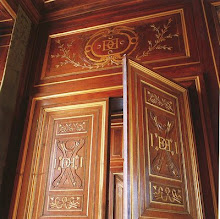
The woodwork is amazing throughout the house, particularly in the entryway. Above is a doorway into the master's study.

The entry into the stairhall, above, is really beautiful and grand.

Above we are peaking through the grand entry into the stairhall.

The window surrounds even have beautiful woodwork. Who wants draperies when they would hide all of this! One of the reasons I feel the house resonated with me was the lack of fussiness but still a lot of gorgeous detailing.

The masters study has these beautiful built-in bookcases with some of Benjamin Chew's original leather bound books.

On the other side of the entry hall is the entrance into the mistresses office.

It does not have the bookcases like the master's study but has this beautiful yellow damask covered chair beside the corner fireplace which contrasted nicely with the french gray painted woodwork.

The stairhall was as impressive as the entryhall. Above we are looking towards the entry. The doorway on your right goes into the dining room while to the left is entry into the Parlor.

The generous size of the stairhall makes the entire house feel larger than it actually is. An addition from the 1870s is seen behind here.

The designer cleverly concealed any knowledge of the addition by detailing the door like a window using mirror. When it is closed, it appears as a window above wainscoting.

The parlor was one of the most elegant rooms I have ever been in (as is the whole house!). A yellow silk damask sofa sits with card tables and some of the most spectacular mirrors!

This one was really unusual. I love the contrast with the rough plaster wall behind. The house is currently undergoing repairs (and we weren't able to tour the 2nd floor).

2 other identical mirrors, one seen above, line the room. As candles were a luxury, these mirrors would reflect the candlelight in the evenings.

The fireplace has some beautiful chinese porcelain, a marble surround and more beautiful painted wood carving.

Part of the restorations are to work on the walls flanking the fireplace and restore original mouldings that had been removed over the course of time. This drawing (which hopefully you can see thanks to photoshop) shows the fake 'doorways' which will flank the fireplace.

The dining room on the other side of the stairhall is set up to match a 1963 Vogue magazine article about the lady of the manor. Interestingly enough, the vogue editor interviewed Mrs. Chew the day Kennedy was assasinated.

Gas and heat were introduced into the house in the 1870s (at the request of the owner's children) and here you can see the original heating grate on the floor of the stairhall. Totally obvious but still beautiful! I hope you have enjoyed the house as much as I did. I will post about the other earlier Georgian house we toured,
Stenton, later this week.
 All this talk lately of new words being added to the English Dictionary (the verb unfriend via facebook?) reminded me of the Academie Francaise which has been in charge of the official French dictionary since being founded by Cardinal Richelieu in 1635.
  The 5 acadamies of the Institut de France (of which the Academie Francaise is the most famous) have been headquartered since 1805 in an amazing Baroque Palace from 1688 which dominates the skyline of St. Germaine along the Seine. It was originally built as the College of four Nations (a college meant for only 60 young noblemen from 4 acquired provinces) with money bequeathed to Louis XIV by Cardinal-Minister Mazarin.
 In the above photos, you see the front facade which faces the Seine. The amazing dome or cupola and public square were designed by the architect Louis Le Vau to relate with and complement the Louvre directly across the river.
 The rear portion is not as imposing but no less grand. These small streets curve around it and are full of lots of treasures to discover: parks, restaurants & charming shops.
 We always knew we were close to the hotel (and a Laduree snack break!) when we saw the beautiful dome.
 In these close up shots, you can see a building that is designed in a most refined manner and wears its' age and the building techniques of the 17th century well. The rear of the building is quite plain with the fine carving being reserved for the front facade (detail seen below).
 We had a direct view of this dome from our hotel room, 2 blocks away, and it was an amazing site to wake up to every morning....
 And watch during the sunset in the evening. Yet another reason St. Germaine was my favorite neighborhood!


 Above is the decoupoge dish I purchased and holds my keys while home. Needless to say, I was so excited to read what his favorite products were as he has sold me some of mine!


 One of the small anti-chambers in the main public space was this incredible small jewel of a room which I spent a good 10 minutes in. The ceiling was painted black with silver leafed stars and gilded rays emanating from a brass chandelier.


 She favors a clean, architectural style so colored window treatments were out of the question. I chose some basic interior white wood shutters instead and was inspired by Victorian stained glass.
 The house is brand new and so new custom windows were out of the question (and budget!), but the mullions in the top pane were perfect to introduce squares of 'art glass'.
 We found some professional grade window film online and after some trial and error (apply the films to WET glass!) and some thought as to arranging the 6 different colors here are the results! We're so pleased!
 These small details really bring the whole house to life! The top 3 images are of the living room while the bottom images are of the master bedroom above. Proof that inspiration from the past can affect our homes today in 'modern' applications.

 Posts
Posts









.JPG)