Were you wondering when I would get to the good stuff from Versailles? I think I've kept you waiting long enough! The most famous room at Versailles is undoubtedly the Hall of Mirrors. I've enabled clicking on my photos so you can zoom into the details.
 I wasn't sure what to expect. I've seen photographs of it my entire life but I was totally blown away.
 Blown away not just by the sumptuousness of every detail: the gilding, the beautiful mirror, the huge crowds, but mainly by the beautiful light.
 The room is immensely long, 239.5' to be exact, and that doesn't include the adjoining Salon of War and the Salon of Peace on either end.
 The light comes from the tall french doors facing the gardens and is reflected into the 17 mirror clad archways opposite. All of the crystal, highly polished marble and gilding don't hurt either!
 At the time of the halls construction in 1678, mirrors were one of the most expensive items to own. Meant as a gathering place at the palace, the mirrors were not just a decorative item but also meant to impress all those waiting for a glimpse of the king.
 I was impressed.
As you can see, so was everyone else! Everyone was jockeying for elbow room to take pictures!
 The hall was designed by the architect Jules Hardouin-Mansart for Louis XIV; would you expect anything less from either man?
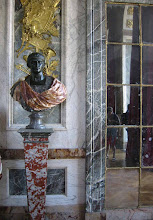
 Beautiful candelabras and statues line the hallway, reflected ten fold by the mirror.
 The views over the gardens are spectacular: I could have spent all day long in this one room.
 I kept pinching myself: am I really here?
 Towards the end of my visit in this great room, I started to pay closer attention to the mirror.
 Does it look ok to you? Hazy maybe?
 Not just old, but there is GRAFFITI on the mirror! At first I was outraged!!!
 Then I started to read what was scratched onto the glass. Most of the inscriptions left behind are from 100-200 years ago. Historical graffiti!
 Somehow that made it much more acceptable to me, is that wrong? This last image has been the screensaver on my home computer since I came back. History refleccts history!
 The hall was designed by the architect Jules Hardouin-Mansart for Louis XIV; would you expect anything less from either man?
 Beautiful candelabras and statues line the hallway, reflected ten fold by the mirror.
 The views over the gardens are spectacular: I could have spent all day long in this one room.
 I kept pinching myself: am I really here?
 Towards the end of my visit in this great room, I started to pay closer attention to the mirror.
 Does it look ok to you? Hazy maybe?
 Not just old, but there is GRAFFITI on the mirror! At first I was outraged!!!
 Then I started to read what was scratched onto the glass. Most of the inscriptions left behind are from 100-200 years ago. Historical graffiti!
 Somehow that made it much more acceptable to me, is that wrong? This last image has been the screensaver on my home computer since I came back. History refleccts history!


 Many things on the property bare the name Clayton. The name is derived from Henry CLAY Frick: The 'ton' relates to the word town.
 Part of the carriagehouse.
 The playhouse was built for the children and is the size of a normal house. It held rooms for the children's toys as well as a bowling alley! Lucky kids! It now holds the giftshop: this is where you will start your tour.
 The conservatory lies next door.
 Across the walkway is an old caretakers cottage which now houses a pretty great restaurant. We didn't get a chance to eat here but I highly recommend it based on past experiences.
 The main house was renovated after the Frick's purchase of a typical Victorian which they renovated into a gracious family home. The only original piece left was the porte cochere seen here below an amazing stained glass & copper bay.
 A closeup of the port cochere columns.
 A shot of the backdoor to end the tour. If you find yourself in Pittsburgh, don't forget to visit, the interiors are spectacular!
 Three house tours in three days. This past weekend I spent 'camping' with some friends in Western Pennsylvania on the grounds of
 Having roots from the area may bias me, but I think Western Pennsylvania in the fall is the most beautiful place on earth. Above, a charming church in Ohiopyle.
 The field behind our house was a meadow filled with wildflowers and views over the surrounding hills. Each night we had these amazing sunsets which I tried to capture here in photographs to no avail.
 I say 'cabin' loosely, it was actually a house from the 1960s which used to belong to the lawyers of the Kaufmann Family.

 Also known as 'Malcolm X Park', the park was officially named Meridian Hill because it was on the exact longitude of the original District of Columbia milestone marker. This land has had many purposes over the years, including being home to the campus of George Washington University (known as Columbian college at the time).
 Dc is known for some of it's art deco apartment buildings, including this one on 16th street facing the park.
 Many grand old mansions line this part of town which mostly now house embassies and organization headquarters.
 The lucky ones are really kept up well and retain a lot of their original details, such as this canopy on one embassy bordering the park.
 I've always loved this community group building which looks a lot like an English country manor plopped down in the city!
 Love these obelisks too!


 If you take the tour of private Versailles, this will be your final stop. Other visitors only get to admire the chapel from the doorway.
  The balcony above the door was where the highest royals and the King would attend services.
 The ceiling mural was recently restored and is truly breathtaking (and not just because you're staring straight above you!).
 If you've seen the movie


 Posts
Posts









.JPG)