I've already blogged about Fonthill and Mercer Tiles, so now I thought I would show you the showcase of Henry Mercer. Built shortly after his home, Fonthill, he started work on a museum to house his numerous collections of art, tools and Americana.
  It is a museum, essentially, to the 'hand-made' everyday items that industrialization was pulling us away from. Before we had cars, stereos, ipods and mass-produced clothing and furniture, society had the items displayed here.
 The building is even more striking than his house. Constructed between 1913 and 1916, the museum reaches 7 stories. An open center atrium was designed to suspend large items and float them for guests to view. Small rooms and alcoves are off the main space with smaller exhibits. Where to look?! Interesting things everywhere! You could spend days here.
 Of course the building is built entirely of reinforced concrete, same as his other projects and contains over 50,000 artifacts!! The building was created a National Historic Landmark in 1985.
So much to see that it's hard to take it all in!! Here is a fireplace in the museum covered with the famous Mercer tiles.
 Unlike his home, these windows are framed RIGHT into the concrete, not into wood!
Again -you can visit the museum's website ONLINE. If you are ever in the Philedelphia area, you must visit! It's also a daytrip from NYC as a 2 1/2 hour drive.


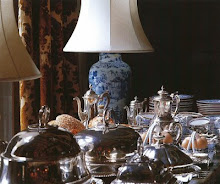
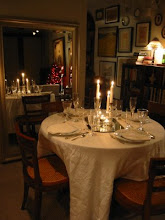
 Are you sick of these table settings yet? It's just fun for me to share! I had a small, informal movie night & dinner last night for a friend (hi Alex and her mom!). As it was a workday with very little time to get ready, I just used the crockpot for the meal and set the table in just 5 minutes when I got home. I try to keep the silver and china all handy, so it can be taken out at a moment's notice. It just makes even a simple dinner an OCCASION!
 I bought these new gold thread & linen placemats at pottery barn today ( 75% off!) to make the table less formal than a tablecloth. The same antique irish linen napkins as usual, grandmother's silver, my minton dinner plates and my favorite (use it daily) cuckoo pattery by wedgewood for the salad plate. I think it came together nicely! Instead of candles, I just used my small alabaster lamp (sort of like an old fashioned dinner club!).
  We watched the
  Last week I wrote about Mercer Tiles (read the post
  Fonthill was built between 1908 and 1912 as a realization of Mercer's dream. It took 8 workers and a horse named Lucy to finish the house of reinforced concrete. You can see the arts & crafts movement very strongly in the design. It is stepping away from industrialization and towards a simpler time when everything was made by hand. If you came upon this house, you would think you had stepped into the english countryside and found a home that was built and added upon for generations. It has 44 rooms, 18 fireplaces, 32 stairwells and over 200 windows; Big dream house!


 I never go outside unless I look like Joan Crawford the movie star. If you want to see the girl next door, go next door. Joan Crawford
 Samuel Mockbee (1944-2001) was a very famous architect: not neccesarily for his own buildings but for the studio he created at Auburn University, the Rural Studio.
 House with wall made out of cardboard scraps
 Lily Friedlander addition - Atlanta, GA.
 interiors of a chapel -which utilized 80 Chevy Caprice windshields at the cost of $120
 Yancey Chapel interior, 1995, made from concrete and old tires!
  the Hale County animal shelter
  restroom at Pearl Landing
 He was aiming to inspire these poor communities into something greater: they deserved better than substandard housing and a substandard life in a rich country. All of the recipients were so proud of their houses and many helped in the construction of them.
 the 'butterfly' house
 bottles cast into this wall of this house in Masons Bend, AL. provide light.
 detail of home created from old license plates adhered to a waxed cardboard frame.
 Many of you have probably heard of Fonthill and the Mercer Museum outside of Philadelphia -the eccentric concrete buildings by Henry Chapman Mercer (1856-1930). One of the things he was best known for was his tile work.
 The tiles are in prominent buildings all around the world -but the largest collection of them is at the Pennsylvania state Capitol building in Harrisburg ( even the Casino in Monte Carlo has Mercer tiles!)
 Here you can see a large selection of tiles adorning a fireplace in the Mercer Museum. I think you can see the strong similarity between these unique tiles and the German stove plates which he collected. There are a large number of these (seen below) still in the Mercer collection.
 Below is the Mercer Museum ( too beautiful to not post!).


 The courtyard was beautifully kept and filled with orange trees (like most of the city) -great for a mid-day snack! I highly recommend this hostel / hotel (make sure to get a private room with private bath, it is a hostel after all!) It was very inexpensive at 28-30 Euro a night! You can find information about it online at
  This beautiful brunch was featured in a beautiful country house in Worstershire. Isn't it a great place to spend a cold winter's day?


 Posts
Posts







.JPG)