Friday, December 22, 2017

Palladio's Villa Rotonda - IN PERSON

When broadly asked what my favorite building is I have always answered "The Villa Rotonda". While in Venice I finally got to see it in person and I can honestly say my answer has not changed (phew)!
The most famous of structures by the most famous of architects, Andrea Palladio, the villa is by definition one of the most perfect examples of classicism; Symmetry, scale, and proportion all reign here.
While we've all seen so many pictures of the house I still found a lot of surprises around each corner.
The first surprise was that the house creates a strong hilltop axis with the family chapel on the other side of the road from the entry drive. Who knew?
 A barn and a retaining wall flank the sloped drive up to the house from the road while a small classical chapel is perched on the hillside opposite - making the visibility of the road disappear from the house much like in a British 'haha'. No, I didn't make a joke, click the link to see what a Haha is!
There is some debate about the architect of the chapel; whether it was Palladio who died in 1580 and never saw completion of the villa or the architect Vincenzo Scamozzi who finished the project.  I would argue for Palladio because such an important axial connection to the house must have been an early decision.
Here are the gates to the driveway and the hoards of German tourists who crowded all my photos!
The barn on the right side of the drive has a wonderful rear facade of its own by Scamozzi -notice the tables and chairs in the loggia? A lovely spot.
 The end of the barn facing the villa has a lovely composition rather than a blank facade.  The small gift shop is just behind here.
The house is completely symmetrical in that all 4 sides are faced with a grand set of stairs to a temple front. Each is only slightly different but who is to know since you can't view each side simultaneously.
 Sitting on a hilltop the house is visible from all sides so by that reasoning it couldn't have a back facade.
The surprise to me was just HOW visible it is to the many neighbors who view the house. It's really in the middle of the Vicenza suburbs and not nestled into the country as so many photos would lead one to believe.
The gardens aren't much to write home about, I suppose the owners realize everyone is visiting for the architecture, but this rear corner with the best views of the surroundings has a nice spot to rest and this lovely old well.
 All 4 sides may be nearly identical but the views and approach of each is completely different.
The stairs have locked storage beneath them but one is able to walk underneath the porches -creating lovely vistas.
 The brick house is completely covered in stucco but the basement alcoves have limestone flooring.
Light reaches basement windows covered by the entry porches via these ingenious light wells covered with bars on the floor of each porch. This keeps the tunnels below from becoming too dark as well.
 I loved seeing the brickwork of the vaulted ceilings below the porches.
Above is a view of the basement as seen from below the porch.  What a lovely spot this would be for a nighttime party! Originally these would have been service spaces.
 But enough of the outside which we all know so well. Should we go in?
Don't forget to wipe your boots of mud.......oh wait that rusted out centuries ago....... Hope you had your tetanus shot.
 Looking out from the house you get a rather cheeky view (there is your haha joke.....).
The interiors are contentious;  Palladio may never have planned for such ornate interiors but owners had different ideas. The quality of the paintings is mediocre at best inside what is probably the best house in the world.
The interior hall below the dome has tromple l'oeil architectural elements while every other surface is practically covered with frescoes.  The purist architect in me wishes the architecture could speak for itself - one barely notices the carved stone details for all of the painted 'noise'. I do love these terrazzo floors though. Some decoration is great but it's easy to have too much. What was it Chanel said?
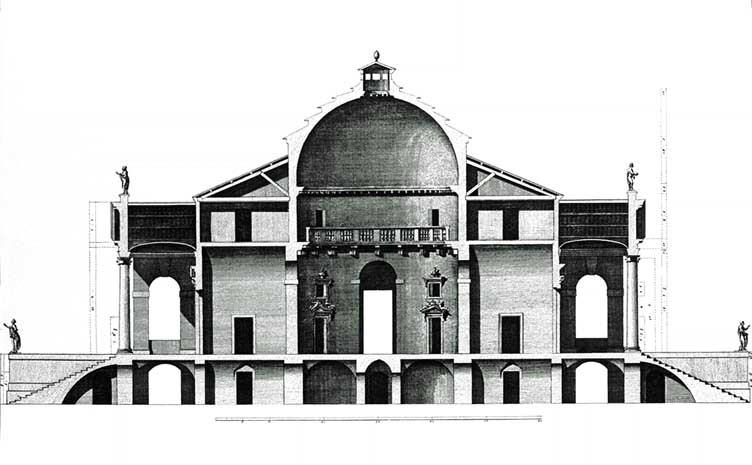
Here in Palladio's section of the villa from his Quattro Libri you can sense the space without the decoration.  All aspects of the design here are mathematically precise per Palladio's rules of architecture defined in his book.
 I mean sure it's great but........
 The ceilings of the 4 principal corner rooms feature ornate plaster coves with central frescoes.
The owners are in residence although 3 of the 4 rooms are left more open for the weekly admittance of tourists.
The living room is used by the family and has modern comfortable furniture. Notice the Villa Rotonda cookie jar on the coffee table? I have one as well, see blog post on it HERE from 10 years ago! Seeing that in-situ was an exciting moment for me.
Of course I had to have my picture taken sitting on the front steps!  I hope you learned a little more about the world's most famous house from my visit!

Thursday, November 30, 2017

Palladio in Vicenza: setting the course of Western architecture.

While in Venice we took a daytrip to the nearby architectural holy land: Vicenza. I say holy land because this was home to Andrea Di Pietro della Gondola - better known as Andrea Palladio.
Architecture enthusiasts from around the world visit Vicenza and they market the Palladian structures widely: maps and sign posts mark points of interest.
If you read this blog I assume you know who Palladio was. If not I'll briefly note he is credited with setting the course of Western Architecture;  the granddaddy of classicism.
Born in 1508, he worked his way up the apprentice ladder to become an accomplished architect in the Vicenza region designing churches, villas, and townhouses. Much of his work, which came as a surprise to me, was renovation to existing structures.
However what sealed his fate as the most well known architect (perhaps ever) is his writing of "The Four Books of Architecture" . This tome was his treatise on architecture featuring his own designs based on ancient Roman architecture and the rediscovered writings of  Vitruvius.
It must be pointed out that Palladio wasn't the only Renaissance architect of the time period working in this medium or even the only one to write a treatise! He had actually fallen into obscurity until being rediscovered in the early 18th century by French and English tourists on their Grand Tour.
His original works, many of them humble brick farm structures covered in stucco, were to be copied for centuries to come in marble and granite throughout the world.
Vicenza is a delightful Italian town and an easy train ride from Venice. Surprisingly clean (compared to other Italian towns, sorry it has to be said) and prosperous seeming, locals mingle with tourists and students in the many shops and cafes along the main streets.
I think one of the more interesting Palladian projects in Vicenza is the Palazzo Porto Breganze which was never completed. Above you can see the 2 bays of the Palazzo and entry as standing since 1571 and below is Palladio's drawing of the entire facade.
Many of his palazzo, or palatial townhouses, are completed throughout the town though as evidenced in these photos.
Another of his more interesting projects is the modest Casa Cogollo completed in 1559, seen below.
Oddly known as the House of Palladio (he never lived here!) the renovation to an existing structure was basically a town ordered facelift to an older house of the town's notary, Pietro Cogollo. The odd blank space above the townhouse's entry is the back of the main level's fireplace, oddly positioned.
The open lower level courtyard still exists, not having been filled in by later commercial space, and is currently being renovated. The windows facing this courtyard provide the light needed for the interiors, especially important as the front facade is blocked by a large and poorly planned fireplace!
Many of the Palazzo house institutions and museums so can be visited by the public. The interiors tend to be rather plain however, or decorated much later, so the exteriors are more interesting.
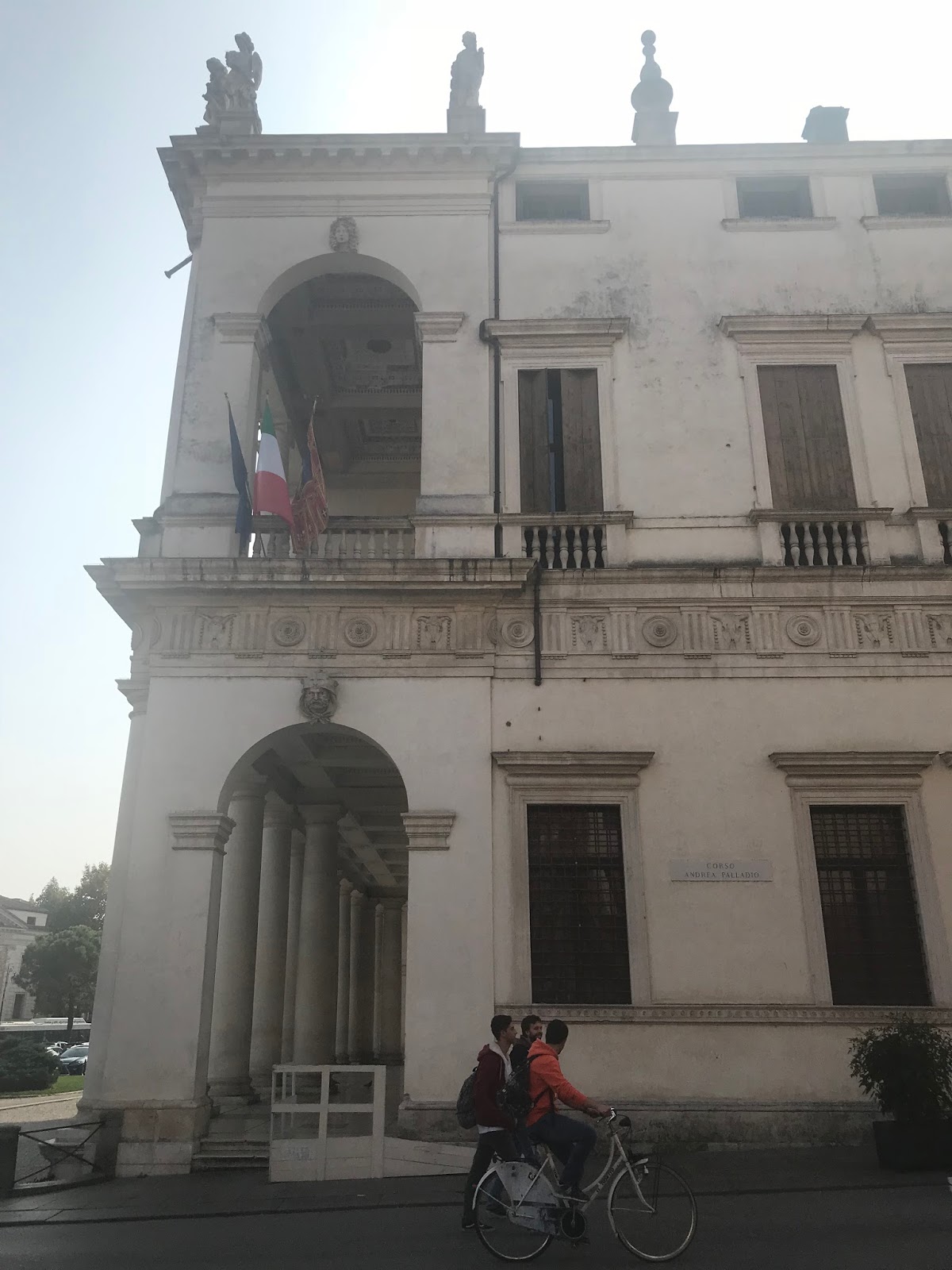
The Palazzo Chiericati is one of the buildings open to the public as it houses an art museum.  See a link to the lovely frescos inside HERE.
The Palazzo was built elevated, unlike his other townhouses, because this town square at the time of design (1550) had 2 streams which met and occasionally flooded.
These streams had been rerouted by the completion of the Palazzo in 1680 but the elevated platform provided privacy from the busy square which dealt in the sales of wood and cattle.
I loved the loggia's coffered ceiling.
Towards the end of his career Palladio was important enough to be working in nearby cosmopolitan Venice. The church known as Il Redentore (seen below) sits on the island of Giudecca facing St Marc's square (blurry photo taken while I waited for the Vaporetto near our apartment).
But of course, the most well known of Palladio's works were the villas. The most famous of these, known as La Rotonda (seen below), is actually a suburban house on the outskirts of Vicenza only 3/4 of a mile from the train station. This was the highlight of my trip which I'll feature in my next blog post.

Thursday, November 2, 2017

Murano: glass in the Venetian Lagoon

I recently returned from a week spent in Venice. While we're all familiar with the pretty lagoon  and palazzo pictures of the city (I took many, I'll share in a later post!) we may not all be as knowledgeable about nearby Murano.
Murano, like Venice, is a series of islands linked by bridges in the Venetian Lagoon, slightly less than a mile north of Venice. Of course the island is known primarily for its glass making.  In 1291 Venice forced all of its famed glassmakers to relocate to remote Murano for fear of fire from their furnaces.
Unlike tourist ridden Venice Murano still feels real; one comes across scenes of laundry hanging out to dry and the school children running amok once school let out.
While dating back to Roman times the island was heavily built up in the 15th century by Venetians who treated the area as a resort. I suspect the building above may date from this time.
The picturesque canals are filled with modern motorboats unlike nearby Venice; these are active canals!
In the center of town is the clock tour.
The church of St Pietro Martire lies at this intersection as well and dates to 1511.  Notice the enormous glass chandelier above. I admit I thought I'd see a lot more glass in use although the town is littered with glass shops catering to tourists. 

As with any good Italian town there are many catholic churches -the charming facade above is the Oratorio Ex Ospizio Briati.
The most well known of the Murano churches is the Church of Santa Maria e San Donato. Dating to the 7th century, the later byzantine mosaic floors of the main chapel date to 1140.
These stunning floors were one of the best things we saw that day!
Ancient lost little corners are to be found throughout the island. I loved the sunlight pouring through this walled garden across the street from the church.
Palazzo dot the larger canals, much like Venice, although these are in more charmingly derelict condition. I highly recommend a visit to the glass museum located in one of these houses, the Palazzo Giustinian. 
Other than exploring this grand palazzo the best part of the museum is the instructive video just off the lobby which shows all of the different glass blowing techniques. 
The collection includes relics from Roman times up to current glass marvels such as this Venini glass vase from 1930. 
This milk glass from the late 18th century mimics much more expensive bone porcelain which was new to Europe at the time.
Next to the instructive video was this beautiful glass sculpture from the last decade: reminds me of a Picasso painting brought to life.
The details of this glass that is 100s of years old is really astounding.
Who doesn't need a huge assembled Murano glass rooster?
This large tabletop decoration or deseri created for the Doge in the 18th century was astoundingly detailed. I've always been obsessed with miniature recreations of houses and gardens.
Would you believe the goblet above with delicate spiral base dates to 1895? It was created for the very first Venice biennale.
Exquisite artistry isn't all old though - this covered goblet above dates from the 1970s.
The making of the famous Murano beads also includes these miniature rolls, seen above.  Tiny glass rods are melted together to create scenes in a log, which are then sliced into cameos for jewelry. Notice the tiny slice above with a gondola and another reading Angelina;  That is smaller than a toenail clipping (but much less disgusting) and barely legible. 
The easiest way to get to Murano from Venice is using the Vaporetto service - sort of like a public bus.  I'm glad we purchased a week long pass as individual rides are around $7 euro each and we had a lot of fun hopping on and off of the boats exploring Venice and nearby islands without worrying about the cost of each trip. Between Murano and Burano are a number of slowly disappearing islands which are being eroded by heavy boat traffic. The history of the island above, the Madonna del Monte, is really interesting - you'll only be able to see it for another few years before it completely falls into the lagoon; read about it HERE.
Much like Paris, Venice is always a good idea. Avoid the big tourist areas around the middle of the day when the horrible cruise ships unload onto the tiny islands; a leisurely lunch will solve that. I went into the trip worrying if we would have enough to do to fill the week and left feeling we barely scratched the surface.
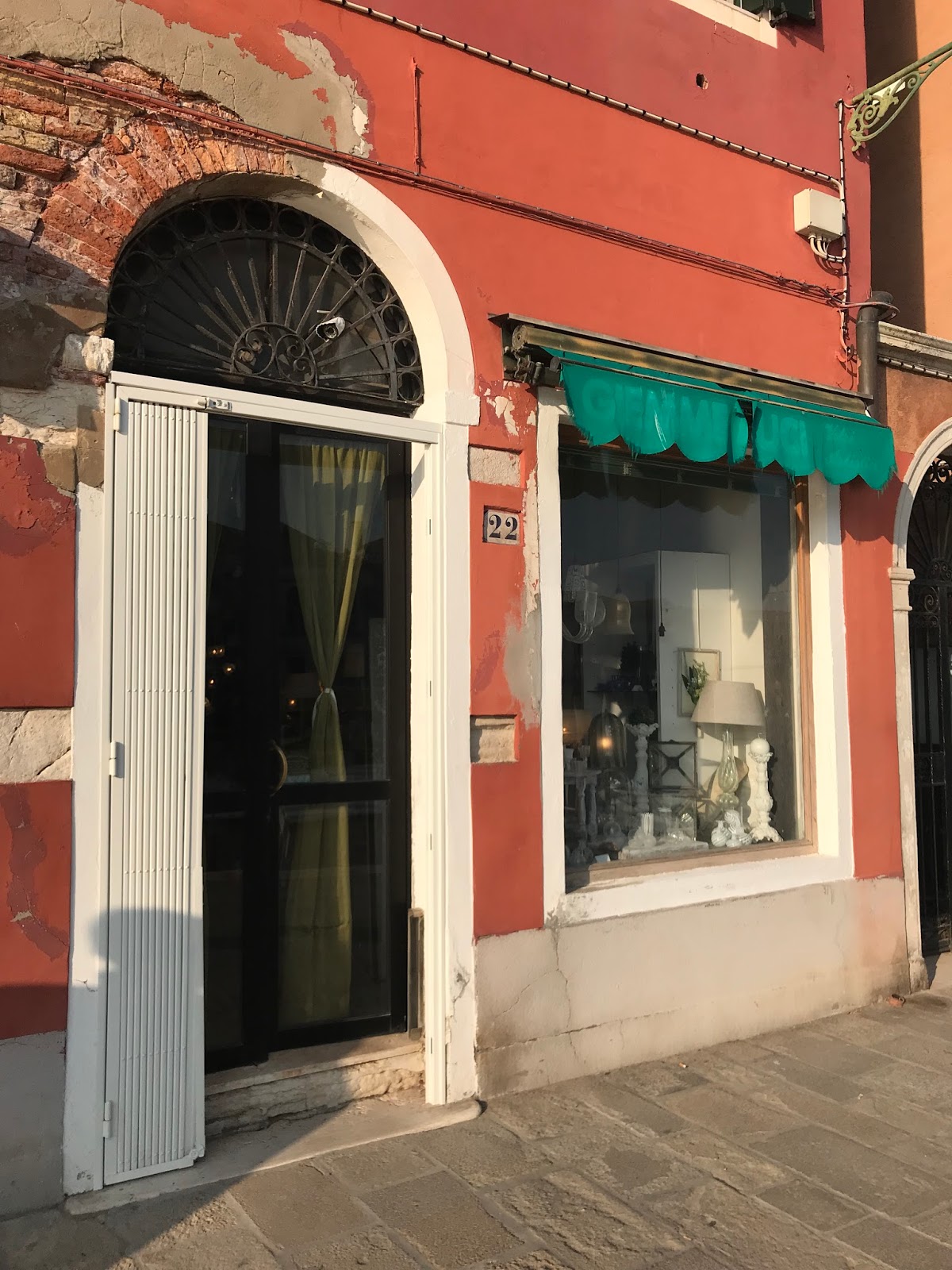
One last note about Murano: Glass shops are plentiful and for small (genuine) souvenirs I highly recommend the family run shop at 22 Riva Longa (the central main canal).  The family business reaches back generations and the current proprietor is designer and shop keeper who is a lot of fun and so knowledgeable about the local glass!