Earlier this week, I attended a lecture at the
Corcoran given by Jose Solis & Paul Sherrill of
Solis Betancourt in celebration of their new book,
Essential Elegance. I know there are a LOT of beautiful books out this season but this one surely deserves its' place as a stocking stuffer (as said by Solis himself!).

Solis Betancourt has been operating out of Washington, DC for 20 years and to celebrate that landmark, they decided to publish a book of some of their favorite projects. One of the first in the book is also one of my favorites (which I've loved ever since I first saw it published), an elegant french styled house here in DC they did in collaboration with
Barnes Vanze Architects.

Above is the living room. In this remarkable renovation, the team turned a pokey little house into an airy and spacious feeling masterpiece with amazing views. One of my favorite parts of the lecture was that they showed the 'befores' for every 'after' which got a lot of gasps from the audience!

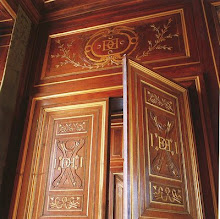
The master bedroom above benefited from the use of Portieres, or curtains to delineate space, a common element found in much of their work. The amazing mahogany windows and french doors from
MQ windows which fill the house don't hurt either! Another ingenius element that often pops up in their work is decorative mouldings on the ceiling in which all of the ugly necessities are ganged; such as air vents, lighting fixtures and smoke detectors.

The use of natural materials and simple, modern furniture in a classical space was important to the client. Solis stated that their work at the firm is extremely client based and personal. This is evidenced by the broad range of styles seen throughout the book. He believes that the process should be 'amazingly fun' for everyone involved and that the client is the most important part of the process.

In another more recently completed project just outside of NYC, Solis collaborated with architect Ward Welch to create a soothing environment for the client as an escape from the city. Solis believes his training as a painter (and also as an architect at Cornell) has trained him to see his interiors as still-lives and he excels at creating vignettes, as in this bedroom above. One of my favorite spaces was a bathroom in the same house. The modern glass sinks benefit from tons of natural light and the contrasting ornate mirrors add a little excitement to the room. I also love when bathrooms are finished like
real rooms with pieces of furniture.

In the end, Solis and Paul left us with some great points. The earlier an interior designer is involved with a project, the better and smoother the end result. Solis believes his training as an architect helped his communication skills with clients, architects and the whole building team and believes that a team process is needed for a coherent project.
Editing is the most crucial part of design and Jose likes to work with existing furniture and architecture when possible, but in new ways; thinking outside of the box.
Jose said that entryways are the most important room of any house as they provide the introduction. He believes that no matter the size, it must give the 'story' of the entire house and he likes to include all of the main materials found throughout: stone,wood, iron, etc.
While Jose tends towards the modern and Paul towards traditional, their work together has created some stunning interiors as proved by this book. No matter whether the house is old or new, they like to provide a bit of
wabi-sabi to the space by adding age and patina to give a sense of history. This one is a must in the fall line-up of interiors books!
principal photography throughout the book was provided by Marcos Galvany
 I love this poster from the National Museum of American History, a branch of the Smithsonians.


 Not only does my friend Marisa currently live in India, she is a world traveler! Along with the Indian pictures she provided me with yesterday, she sent these enticing photos from her recent trip to Istanbul.
 The colors in the skyline photograph surprised me. I think I always pictured the city as dry and dusty, not lush and green. But what the city is most well known for are its' mosques.
  Dominating the skyline is the Blue Mosque, or Sultan Ahmed Mosque, which dates back to 1609. The blue in the name refers to the blue tiled interior.


 And what is a trip to Turkey without a Turkish bath? Great architecture, beautiful views, fascinating history and a spa trip rolled into one. This just may be another destination to add to the list after India!
  You may have noticed on her


 The house revolved around entertaining and a large main entertaining room was located just inside off the entry court. The ceiling was studded with holes into the private rooms above to look like starlight, which also provided views of guests below so that the family could decide what to appropriately wear to greet their guests. Another efficient and ingenius idea!

 I think the lesson here is that Gaudi knew when his buildings should be stand out stars, and when they should be background structures. They can't all be masterpieces; sometimes a house is just a house, no matter how extraordinary!

 Posts
Posts










.JPG)