Nestled against the
Parc Monceau in the chic 8th arrondissement is one of the most famous house museums of Paris, the
Musee Nissim de Camondo managed by the
musee des arts decoratifs (see my posts on that wonderful museum adjacent to the Louvre at the link). I had always wanted to visit this storied house but never had a chance until my last visit -I shouldn't have waited!
Located on a tony street where many of the grand houses have become foundations, headquarters of international corporations, or embassies -the back of these structures front the Parc Monceau, many boasting private entrances into the park.
Built in 1911 by a wealthy banker, the
Count Moise de Camondo, to house his collection of 18th century furniture, the house was designed by
Rene Sergent to combine the best of 18th century living with the most modern conveniences of the time, replacing the much larger home of his father (see the floorplan below).
The story of this most elegant house however is a very sad one.The count's son died during WWI and he donated the house and his collections to the Decorative Arts museum in his son's honor which opened to the public in 1935. A few years later the remainder of his family were murdered at Auschwitz. This is therefore not a happy family home but rather has survived as a testament to the endurance of this generous public donation, securing the Camondo legacy.
The unprepossessing street front, seen above, housed the Count's offices as well as a garage.

Once through this public area a gravel courtyard welcomes one to the house, clearly based upon the Petit Trianon (see my many posts on the Petit Trianon
HERE).
In a very clever application the beautiful blue/gray treillage seen above screens the view of the courtyard from the neighboring apartment building. The combination of the limestone, gravel court, boxed topiaries, and treillage makes this perhaps the most Parisian house in all of Paris!
Visit the blog of
The Devoted Classicist HERE for more on the story of the house and also
HERE at
Mansion Floor Plans and don't miss more photos at HabituallyChic
HERE.
The roof you see above the garage doors was an outdoor pathway connecting the private study of the Count to his offices which face the street.
Above you are standing at the front door of the house looking through the offices to the street.
You can see above, in a view taken from the 2nd floor of the house, that the doors on this side of the courtyard flank a service courtyard and garage (now housing museum offices).
I love the continuity of Parisian architecture: the same warm 'french grays' and blue-gray trim prevail throughout the city lending a cohesion to the disparate building styles.
Notice the interesting Greek key base on the lanterns which light the courtyard above.
The backyard is rather formal, but who needs a backyard when you have private access to the
Park Monceau!
The parterre were still beautiful despite their autumnal lack of color. Imagine being the gardener responsible for keeping all of this gravel raked and weed-free!
One gets a sense of the level of detail to the limestone facade when looking out the windows on the 2nd, or private, floor.
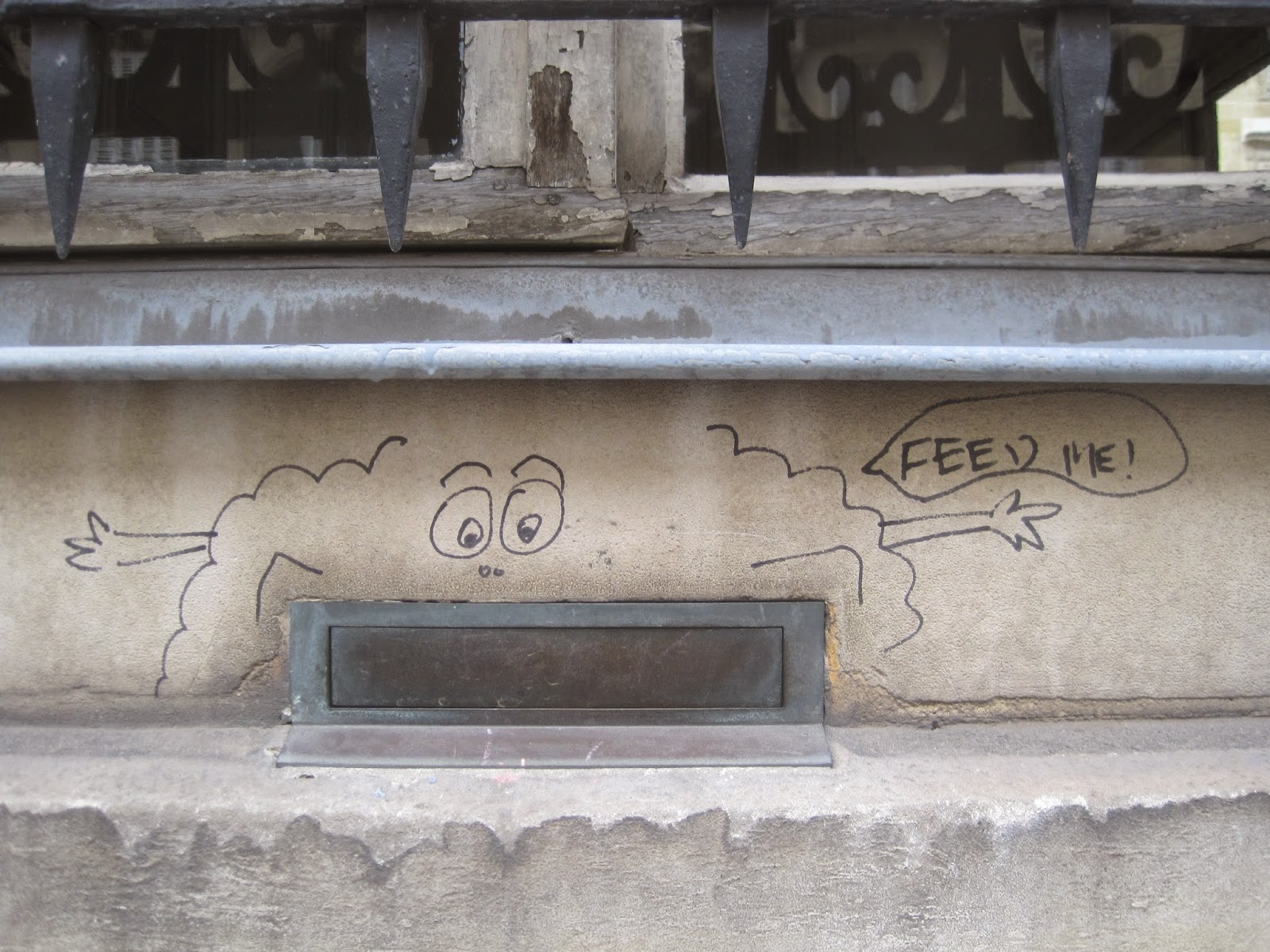
Notice the netting to keep birds from nesting on the statuary. I am normally against any sort of graffiti but I can't help but admire what some 'artist' had done to the building's mailbox on the street facade!
Next I will post some of my highlights on the much-published interiors. You may also want to check out the fantastic book, "
The Camondo Legacy" by
Jean-Marie del Moral if you can find a copy.
As always, images in this post are my own.




 One of the MUSTS for me in Paris was to visit the galleries of the
  The museum fills an enormous wing of the Louvre with one collection (by period) per floor. I was most excited to visit the collection of 18th century arts where we spent most of our time; and you can't have a display of 18th century decorative arts without some chinoiserie.
 A small display showed off the best of the best. Displayed against red lacquer panels, I think my favorite aspect was how colorful it all was!
 Above you see a lot of items that show the rococo influence also popular at the time. Chinoiserie really gained stride through rococo as the fantasty of it really mixed well with the design style's ideals. However, by the late 18th century, strict neoclassicism was in vogue and fanciful chinoiserie was mostly out. Chinoiserie wasn't about accurate Chinese design but rather a westerner's take on it: theater.
 The movement of chinoiserie really began with the import of china from the 'far east' in the 17th century and spread from there to include other household items, even entire buildings (although the style was mostly relegated to follies or particular rooms).
 Chinoiserie was especially popular in France, thanks in part to Louis XIV and Madame du Barry who had a special fondness for it. Even the term is French (chinese-esque)!
 I'll end with this fantastic French barometer / thermometer which was in a case with a lot of china (which you know I loved). Small statues of men are housed in a pagoda form, on which rests a small tube of mercury (see it between the 2 statues at the base). Now if only I could find something like this on ebay......

 Posts
Posts







.JPG)