Showing posts with label Vienna. Show all posts

Tuesday, February 28, 2017

Schonbrunn; Another post another Palace.

Since I mentioned it in my last post on Vienna's Belvedere I thought I should write next about Schonbrunn Palace. Sick of palaces yet? I saw so many on my trip that there is so much to share!
 A rare image of me, ArchitectDesign, as it was the only picture I have that includes the front entry court.  Yes I can play typical tourist and get my picture taken in front of the Eiffel Tower, haha!  I'm blinking, which is one of many reasons I never have my picture taken or post them on my blog. Back to architecture....
A mansion has been on these grounds since before the 15th century as there is a fresh spring (hence the name Schon Brunn or "beautiful spring" in German) but the present building could finally be termed palace when it was added onto by the widow of Ferdinand II, Eleonora Gonzaga, and finished in 1643.
The large grounds just outside of Imperial Vienna made this the perfect summer estate for the Habsburgs.
The present palace owes its' baroque interiors to Empress Maria Theresa, known to most of us as the mother of Marie Antoinette, who remodeled the palace from 1740 until 1750 after receiving it as a wedding gift. The exterior was later renovated by Francis II to the Neoclassical facade we see today.
Since 1918, at the downfall of the Habsburg monarchy, the palace and grounds have been open to the public.
Interior photos of the palace are not allowed so you'll have to find those online (check the official website here) but while waiting in line for my tour I did snap this shot of the lovely lanterns; notice the gilded crown integrated onto the top of the fixture.
Much like at the Belvedere, the emphasis again is not on the lovely (if someone bland) palace but on the gardens.
This private fenced garden on the west of the palace (#5 on the map above) was used by the family as their private yard and where the royal children would go out to play.
These lovely trellised pavilions set into the garden are lovely spots to sit.
It doesn't get better than this.
Right behind the palace is the most famous part of Schonbrunn, the Gloriette, perched high on a hill overlooking the palace and the suburb in which it sits.
I believe I've mentioned before that without fail, the best things I'm traveling to see are under renovation. Never travel with me! For that reason see above lovely photograph of the Gloriette high above the Neptune fountain from wikipedia.
Scaffolding companies should pay me to go on vacation - I would keep them in business.
The Gloriette originally was an imperial banquet hall and now houses one of the many cafes found around the Schonbrunn grounds.
The hard thing to capture in my snapshots is the grand scale of everything. It's a LONG walk from the palace and up the 200 foot tall hill to the Gloriette.
The large grounds provide a lot of different things to see; fountains, pavilions, and even a full zoo!
All of the building fit with the palace in a soft yellow stucco with red clay tile roofs.
Don't miss the "Roman Ruins" (#12 on the map above) designed in 1778.
The orangery now houses a world famous marionette theater.
While this was the one day of our trip without much rain the weather still wasn't very cooperative but we still enjoyed our visit to Schonbrunn.
Much like Paris's Versailles (to which is it often compared), Schonbrunn is a short metro ride outside of central Vienna and well worth the time and effort and kept in immaculate shape.
Visit Schonbrunn's website HERE.

Friday, February 24, 2017

The Belvedere, or Mr. Belvedere to you.

Just outside of the Ringstrasse in Vienna, Austria, is arguably the most famous palace in Austria, the Belvedere. This complex was also one of the first art galleries open to the public in Europe since 1776 based on Enlightened Absolutism.
The complex is so impressive Sophia Coppola used it in her movie, Marie Antoinette, as a stand in for Antoinette's childhood home, more properly Schonbrunn. I also visited Schonbrunn on my trip and can attest that the Belvedere, while smaller, is a much more beautiful palace.
Sitting high above the historic center of Vienna the view has not changed much since the 18th century when Canaletto captured it in the above painting (1758) - compare my photograph with the painting; a few more trees and thats all.
The main event of the palaces however is not the architecture but the baroque gardens. Dominique Girard, who had worked earlier at Versailles, designed the gardens here with flowing fountains and intensely planted beds which are now unfortunately grassed over.
On the uphill side of the palace, oddly facing away from town, is the front entrance with a lovely glassed in porte cochere.
Work began in 1712 under architect Johann Lukas von Hildebrandt as the country residence of Prince Eugene of Savoy. While the surrounding area was countryside at the purchase of the property in 1697 it was surrounded by development only a few years later and the Prince was forced to buy more land in order to preserve his city views.
Rather than my snapshots taken on such a gloomy day (my entire 4 day trip to Vienna was rainy!) I thought I'd share more professional photography from Wikipedia. Above is the entrance facade.
The lower Belvedere remained a royal residence for much longer than the upper Belvedere, becoming home to a host of discarded Royals fleeing the French revolution including Marie Antoinette's daughter, Marie Therese.  Below is the lower Belvedere seen from the terraced gardens.
The Lower Belvedere also became a public museum in 1811 when it was used to house the Imperial Collection from Ambras Castle when the Habsburg's lost Tyrol to Bavaria.
And another better image on a lovelier day from Wikipedia.
The baroque gates into the complex are impressive.
Public entrance into the park is through a lovely wing of the lower Belvedere seen below.
As this is now a busy residential part of the city many people use the park to walk their dogs or jog.
Of course all royal residences had connections to a Catholic church. Seen below is the backend of the cloisters of Maria Heimsuchung and the Salesianerinnenkirche (say that 3 times fast).
Not a bad little church at which to say your prayers.
The church boasts a famous organ by Elias Hossler and a lovely baroque facade by Italian architect Donato Felice D'Allio.
Even on a cloudy day the gardens were delightful, particularly the fountains and statuary.
Click on the photo in order to view these larger.
This is however a working art museum so modern sculptures have been inserted into the landscape as well.
Badly damaged during WWII both palaces and the gardens have been expertly reconstructed.
This part of the upper Belvedere housed a lovely restaurant which I recommend!
The restaurant faces out towards a highly stylized apple orchard with lovely teahouse.
I had to share the sign below which caught my eye....I suppose as a meeting point for groups but it was a bit odd and took me ages to figure out what it meant. Of course the many 'stay off the lawn' signs send a mixed signal with this meeting point.
The Belvedere was one of my favorite spots in Vienna and I hope you take the time to visit someday! More information here.

Wednesday, February 8, 2017

If it ain't baroque - Karlskirche, Vienna

Vienna is a city known for its' baroque architecture and within that city the best example is the Karlskirche.
Consecrated in 1737 the Roman Catholic church was built by Emperor Charles IV in honor of the saint Charles Borromeo.   Borromeo is revered as the saint of plague sufferers and Vienna had suffered its last tremendous plague in 1712 (construction began in 1713). 
The prolific Viennese architect Johann Bernhard Fischer von Erlach designed the church which was later finished after his death by his son Joseph Emanuel.
 Located in the narthex is this wonderful clay model of the church.
 Above the altar the gold statue represents the symbol Yahweh. The high altarpiece below shows the intercession of Charles Borromeo.
 Many of the churches in Vienna had wonderfully ornate glassy interior bay windows overlooking the Apse.  I can't help but wonder who these were built to house!
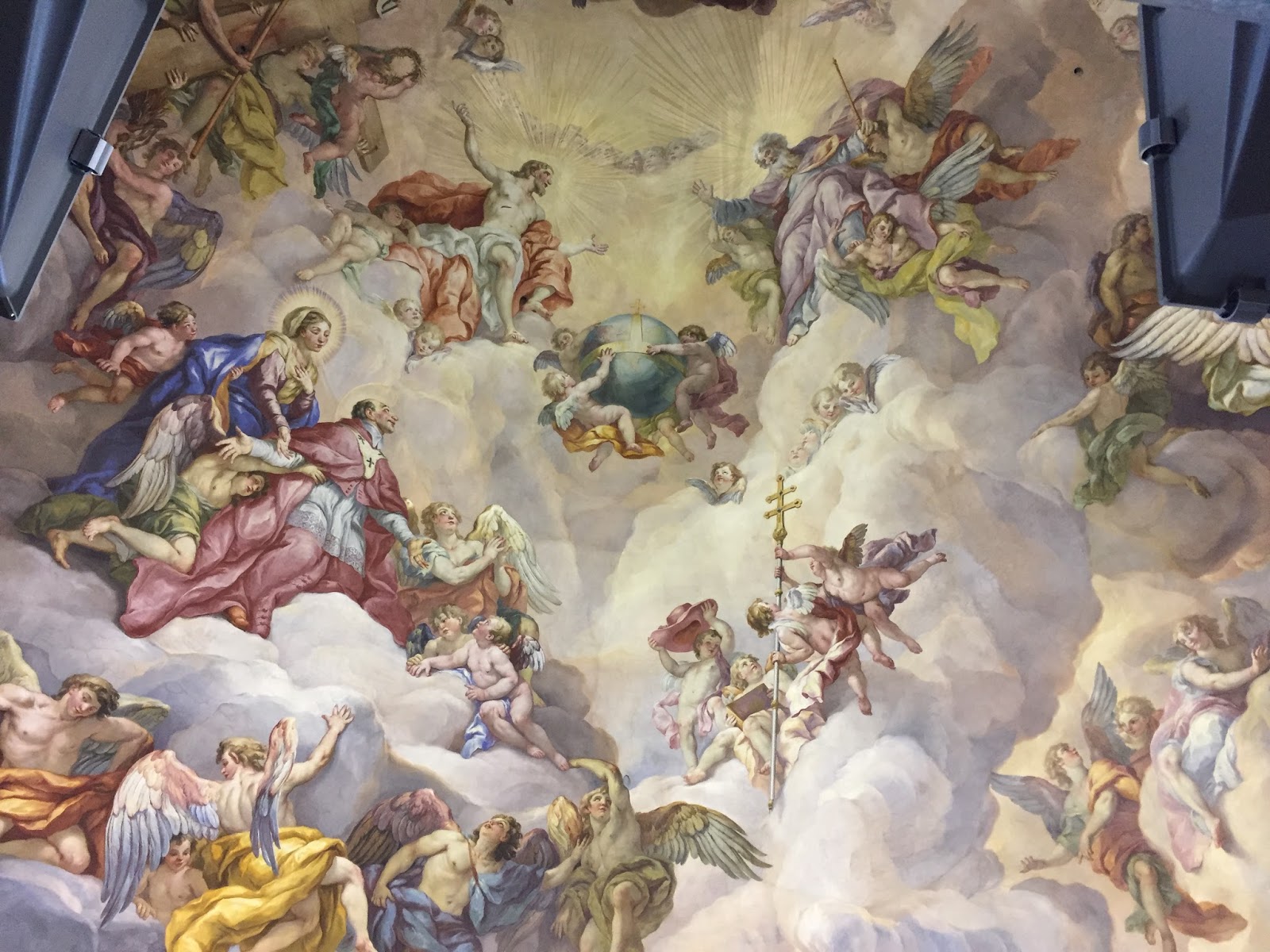
 Many of the frescos are by the important artist Daniel Gran and were recently restored. Gran's restrained later works (such as that here at Karlskirche)  were a precursor of classicism after the excesses of the baroque.
 Notice the huge marble columns. I love the little pavilion type confessionals.
 Even the pews are marvelously designed.
 A number of the side chapels are just as beautiful as the main Altarpiece. A bit of trivia...actress Hedy Lamarr was married here in 1933!
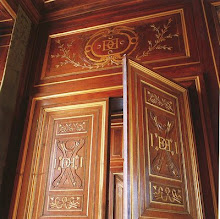
 The impressive walnut front doors are deceptively large but only opened for special occasions. One enters now through the side pavilions seen flanking the church.
I loved these simple candlesticks mounted to the wall in contrast to the ornate decorative scheme.
 Have you noticed the steel scaffolding in a few of the pictures? In order to raise funds for the maintenance of the church, after the restoration the church left a platform below the dome that one can ascend to view the dome's frescos up close and personal, as well as enter the higher lantern atop the dome to take in views of the city.
It's a tad shaky but I was assured it was safe! An elevator takes you to the base of the dome. From there stairs take you up into the lantern.
 This is an adventure not for those afraid of heights.
 Shall we go up?
 From the various landings one gets up close to the wonderfully colorful frescos. These figures are all life size or more.
 You'll want to spend your time soaking in all of the many stories told by the figures.
 I easily spent an hour admiring the many paintings.
 Notice the double ringed walkway around the exterior. I wish I could have explored in there!
 Don't forget to click on the photos to enlarge them to see the details.

From the floor of the church the base of the lantern (at the top of the dome) appears to be marble. However up close it's a very crude faux-marble technique.
 The details of these corbeled brackets is lost to those on the ground.
 Once you reach the top landing you are treated to the ceiling fresco on the lantern.
 And marvelous 360 degree views of the city!
This was one of my favorite sites in Vienna and I hope if you ever find yourself in Austria you will visit the Karlskirche.
 Visit their official website HERE.