Adjacent to C
airnwood and the
Bryn Athyn Cathedral sits Glencairn. The other structures pale by comparison as this house dominates the nearby landscape with its main 7 story tower.

Raymond Pitcairn and his wife Mildred Glenn built Glencairn (hence the name Glen - cairn) as their family home between 1928 and 1939 adjacent to
Cairnwood, the family seat, where they lived during contruction. Above you can see just HOW close.

As at Cairnwood, views of the cathedral are found throughout the house.

Raymond was thus not only working on his Cathedral at this time but also on his own house and the similarities are striking. Romanesque details that he couldn't accomodate on the cathedral are instead used on his own medieval house/castle.

Despite its eccentrically spooky design and enormous size this was every bit a family home for his 9 children (8 are depicted as corbels on this balcony seen above). Interestingly enough, some of the children chose to share bedrooms.

Here unlike at the Cathedral, Raymond was able to complete a finished cloister which makes a lovely private garden for the house.

Now housing a museum of Raymond's religious artifacts, the house has changed little since his time in residence.

I loved these 2 ancient benches built into the wall with a view of the valley below.

High above the cloister is a porch off the master bedroom.

Details such as this stair articulated on the exterior had me so excited to go inside!

The front door sits basically on the back of the house under the tall tower.

As at the cathedral, the details here are amazing. Notice the name etched in stone over the heavy metal doors.

The entry is lavishly covered with beautiful marble mosaics.

Never forget though that this is a very modern house and was a family home. The modern day conviences are nicely disguised, like this electrical outlet above (if you can even find it - that is some amazing faux painting).

The stone is so beautiful and suits the collection nicely.

Off of the entry is the dining room with a terrific brick, groin-vaulted ceiling.

I adored the painting over the fireplace. Notice too that the lighting conduit is expertly faux-painted to blend in with the brick.

The Great Hall (or living room) sits off the dining room and is certainly an awe-inspiring space.

Despite the size little elements bring the room down to human scale, such as the bookcases..

Or the inglenook at the fireplace. Much of this custom furniture and the wood throughout the house is from the same stock of teak wood used at the cathedral.

The opening between the dining and great hall is beautifully mosaic'd as well.

Notice the glass railing on the balcony above.

The concrete stairs taking you up to the bedrooms in the tower is poured concrete and painstakingly decorated.

The hallways upstairs are also of stone and no design detail is spared or overlooked.

The cozy family chapel here is similar in size to the one next door at Cairnwood.

This one is a tad more ornate of course. Mosaic'd ceiling and with Raymond's passion, beautiful stained glass windows.

Localized lighting is key in warming the stone and creating intimate spaces.

Down the hall from the chapel is the library or family room, probably my favorite space.

Imagine a roaring fire in here and an afternoon spent perusing the bookshelves.

Off the library is the master bedroom; surprisingly intimate for such a grand house.

Much of the furniture was made specially for the house and designed by Raymond, while the rest speaks of a family home of the time period.

Each bedroom features a stone niche for a bible, seen beside the gorgeous crib.

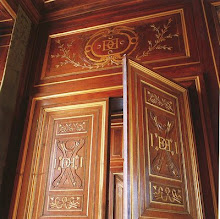
I loved the detail on this door's panels - it opens to feature a dressing mirror!

The master bathroom is covered with beautiful marble slabs and brass fixtures: even the shaving sink is stone.

Mosaics have a place here as well. I've always loved glass towel rods.

The vanity is also of teak and matches others found throughout the house. A sleeping porch is located off the bathroom (seen from the cloister below).

And what is located up the tower you may wonder? A metal and glass sunroom sits neatly within a large covered terrace with amazing views of the valley below.

I hope you enjoyed this tour of eccentric and wonderful
Glencairn as much as I, or even half as much!
 Recently I was asked by the crew over at Novica to help share and rate their services. Novica is a fair trade artisan website run in conjunction with National Geographic. It's a great cause giving work to artisans in 3rd world countries but also makes for a lot of fun shopping; a sort of international etsy! I chose to purchase a sculpture of Mercury from the artist Claudio Aun in Brazil.
  The item arrived shockingly fast considering it was an international purchase and was packaged very safely. I even received a nice note from the artist thanking me for my purchase! What about an African Walking stick instead of a boring metal cane for an ill friend; much more stylish. Or some jewelry for a birthday? Next time you're in the mood to do some online shopping or need to find a special gift, consider Novica.


 Located adjacent to
  The Cathedral is the seat of the "New Church" and was donated by John Pitcairn and was mainly designed by his son Raymond Pitcairn.
  Of course the benefit to this location is that each room of the house (Cairnwood) is afforded picturesque views of a gorgeous cathedral. Plus the commute to chapel for the religious Pitcairn family was definitely convienent!
 The main bulk of the structure was started in 1913 and finished in 1919. Designed in an early Gothic style, later smaller additions (designed by Raymond) are in Norman Romanesque.
  Strangely enough, this style is historically earlier creating the impression that the larger main tower was built later.
 Beside the tower is a leg of a cloister which was designed to be fully enclosed (creating a square courtyard) but was never completed.
  Here you can see the beautiful detail to the stonework.
 The church sees a lot of active use as you can see by the furnishings and immaculate cleanliness.
 Stone as far as the eye can see.
 The superb craftsmanship of everything makes this building so special, just look at these door handles.
 Everything is as special as a Cathedral should be.
 I loved this little private side door off an intimate garden.
 No detail was overlooked.
 The details of this side exterior stair were really incredible.
 Ezekials Tower, seen here, was completed in 1926 and lies off to the side of the main structure.
 Again, I just couldn't get over the amount of detail.
 Even each little basement window grate was different and a work of art.
 Before going inside, lets take a look at the floorplan.
  If you look closely, you can see that nothing was built straight. This was purposeful and not a result of being done mainly without drawings (in the 20th century no less!). This mimic'd ancient cathedrals of Europe where it was also done intentionally.
  To the North of the church lies Michael's Tower (the main entrance) and the choir hall (seen above).
 Can you believe this cathedral is in rural Pennsylvania?!
 All of the wood seen here is teak and the Pitcairn's bought an entire boatload of the wood which had been an order left by someone else (who doesn't love a deal). Teak is used for ceilings and doors here at the Cathedral as well as in Raymond's own amazing house which I will show you next week. The guide I spoke too said the family still has a barn full of the unused teak!
 Fittingly enough Raymond developed the techniques used in creating all of the stained glass on the grounds of Cairnwood. I say fitting as part of the families' fortune, if you will remember, came from the forming of PPG (Pittsburgh Plate Glass).
 Raymond collected and studied medieval stained glass to replicate the lost techniques used.
  The details on these windows are incredible and you would never guess many were created as late as the 1960s.


 Posts
Posts







.jpg)





.JPG)