Showing posts with label English country house. Show all posts

Monday, July 1, 2019

Robert Adam's Entrance Hall at Osterley House

After the Etruscan dressing room the Entrance Hall at Osterley House must be my favorite room in England.
The space is so good that in fact it was the only room to be directly COPIED on a sound stage for the filming of The Grass is Greener - in which it appears for only a matter of moments.  That's a lot of expense although perhaps it was used in scenes which hit the editing room floor?  I wonder what happened to the scenery after filming?
Above is Cary Grant on a brief walk through the house (actually sets on a London sound stage) with his butler before opening to the paying public in The Grass is Greener.
Although it was meant as the Entrance Hall today on a tour of the house it's actually one of the last rooms you see; although you catch a glimpse of it from the long gallery central doors (below) earlier in the tour.  Those are the 'front doors' of the house.
The Entrance Hall was completely redesigned by Robert Adam during the extensive renovations to the Tudor house by removing one portion of the block of the house, essentially creating a U shaped plan.  One enters up a grand exterior stair and through what was formerly a totally enclosed courtyard which makes for a truly impressive processional entrance. The wing of the house which was removed was replaced with a classical screen which acts as a covered porch. Even the ceiling of that outdoor space has elaborate plaster-work.  One only wishes the current tour took this same path rather than in through the family entrance past service spaces on the Ground floor.
The hall was used for more than just grand entrances though; the family would use the room for dining and overflow from the long gallery during the weekend parties and balls they would throw.
Every inch of this space and surface is designed to complement all aspects of the room. The floor reflects the ceiling, the wall panels encase armorial panels, and even the furniture was designed by Adam.
 The soft french grey and ivory white are excellent foils for the limestone floors and mantelpieces.
These lovely 3-branch oil-lamp sconces designed by Adam grace elaborate plaster brackets. These would make for fantastic electric uplights today!
 At either end of the room are apses which function as inglenooks without the built-in seating.
The flowers in the firebox are decidedly odd but don't distract from the perfection of every detail. 
 This limestone mantel would be stunning on a flat wall let along softly and impressively curved to fit the wall.
Imagine having to do the math to figure out the details of the curved ceiling - no 2 pieces are alike.
 Notice too the built-in window seats facing the courtyard.
 I think mahogany doors within painted trim are one of my favorite details in life.
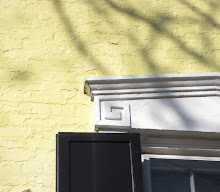
The Greek key cornice, which normally would be one of the first things I'd notice, is almost lost amongst the exuberant plaster-work.
 Greek key too in the classical overdoor (and who doesn't love an enfilade?).
The small vestibules on either end of the entrance hall have the most beautiful groin vaulted ceilings perhaps I have ever seen. A shame more discreet smoke detectors could not be found! Perhaps it would be better more in alignment with the pattern?
Here I leave you with the recommendation to visit Osterley House & Park on your next visit to London!

Wednesday, June 26, 2019

Etruscan dressing room at Osterley Park

I recently took a birthday trip to England to fulfill a lifelong obsession with English Country houses by touring 8 houses in 8 days. Many of these houses only survive thanks to the National Trust and visitors. I have to say they are exquisitely run with great cafes, well maintained gardens, and really good gift shops (I bought a tea towel for the kitchen at each house).  With a membership to the National Trust (or their sister organization The Royal Oak Foundation) you gain access to many of these houses for free and help in their preservation.  American house museums take note, you have a lot to learn from the British!
Rather than share over 2,000 photos I took and bore everyone to death I thought I might perhaps share a highlight.  Both my favorite house AND my favorite room are the one and only Osterley Park by Robert Adam and the Etruscan dressing room.
I first became aware of the house not through any scholarly research on Robert Adam but rather through my love of film. The house has been featured in dozens over movies over the years and uses the fees to help in restoration as well as raise awareness(brilliant!). In fact a portion of the house was closed the day we visited due to filming; I missed the upstairs family bedrooms, the library, and most of the service spaces on the ground floor (although saw what was the nicest servants hall in all of England I would bet).
My favorite movie featuring the house is the charming "The Grass is Greener" from 1960 featuring Cary Grant, Deborah Kerr, Robert Mitchum, and Jean Simmons. While only the exterior of the house was actually used in filming, a number of the interiors were used as inspiration for the extravagant sound-stage sets (more on that in my next post).
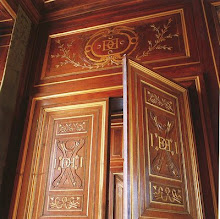
The State bedchamber is one of the major public spaces off the gallery and salons, never really used for sleeping, and the Etruscan dressing room was really more of a sitting room. It all starts with the doors, below.
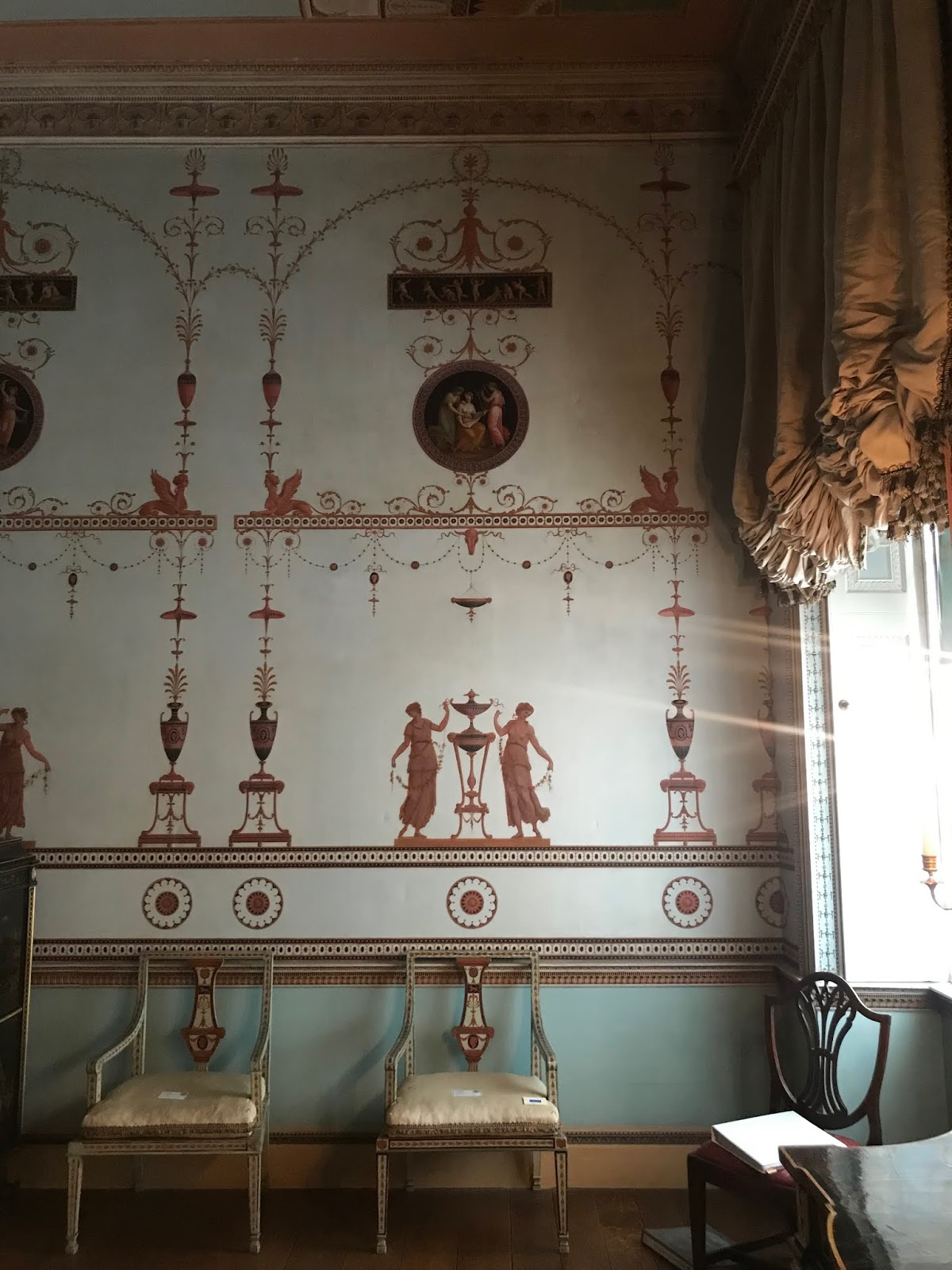
Probably the most scholarly room in the house, Adam took 4 years to research the design of the motifs scattered around the space (1754-1758) during his 20 years of completely renovating this Tudor house from top to bottom into the height of (his brand of) classicism. As throughout the house he designed everything: trim work, wall treatments, furniture, curtains, in fact everything down to the very design for the firescreen which the lady of the house embroidered. Actually, his first design was overly complicated for Mrs Child so he designed a 2nd simpler version.
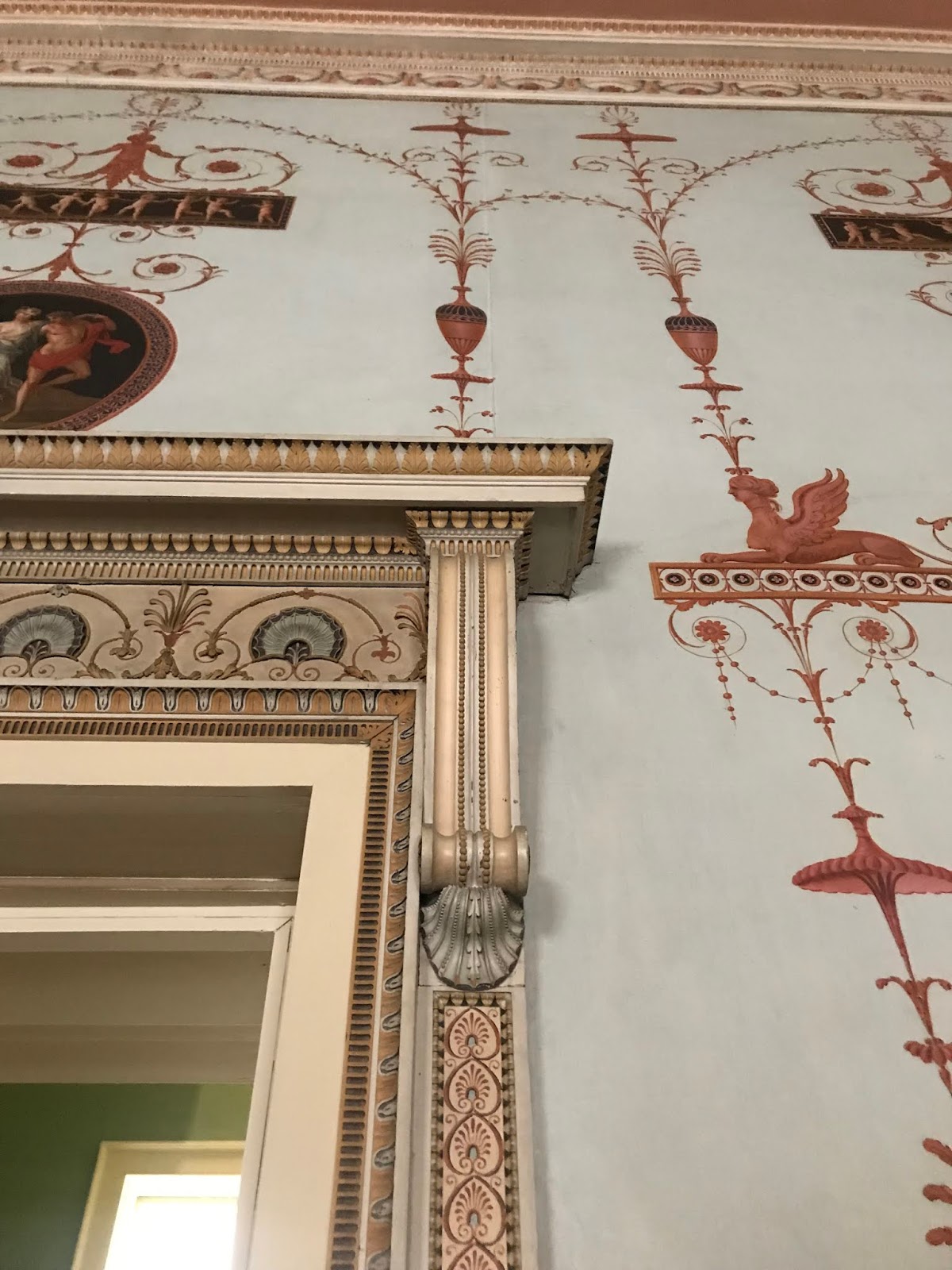
Most of the designs are individually hand painted onto paper and pasted onto the walls: almost like decoupage. Imagine having to paint dozens of identical decorations!
While the house was built in the 16th century, in 1761 the owners of the house, the Child banking family, hired Robert Adam to renovate the house on the outskirts of London into a weekend party house for entertaining.  It stayed in the family until 1939 when it was opened for public tours and then it was used by the government during WWII.  This is a very abbreviated version of its history but we're here for pretty pictures, not a full history lesson.
The reason the entire Adam's design stayed intact was the house was never actually fully lived in and was only one of many houses within the family. The house was given to the National Trust in 1991 and some of the artwork (removed by the 9th Earl of Jersey in 1947) has slowly been returned by the family.  The furniture stayed together as a collection because it was sold to the V&A after WWII and so was returned to the house.
I apologize for so many of my photographs but it was all so beautiful I couldn't weed any out!
Notice how the details in the woodwork are all picked out in different colors. Imagine painting all of that with a tiny little brush!
Here is the aforementioned firescreen designed by Adam for Lady Child.  These firescreens kept the heat of the fire from melting the makeup from the faces of women (and probably some men given the time period!).
The details in the frame were just amazing - grey background with black and red detailing -yes please!
Keep in mind this was the 18th century and everything you see was hand carved: so intricate!
Lion motifs everywhere. I love the ribbed and swirled base.
A pineapple finial for hospitality.
The fireplace garnitures are also just painted onto the wall on either side of the mantel.
Notice the pin prick in the center of the motif above? That's from the compass used to draw the circles.
This chair-rail almost looked Egyptian to me with the leaves at the very bottom. I love that when you see everything from afar it looks crisp and perfect but when you get close you see the wonkiness and can tell its all hand done.
So many patterns. Notice below the jambs of the integrated window shutters with the swags and urns? That just screams Robert Adam to me.
See a great video of the house exterior and interior on youtube HERE
Read more about the Childs family and Robert Adam HERE at a great blog, lostpastremembered.
Visit the house yourself and be sure to stop in the cafe for lunch HERE.
All photos with the exception of the movie poster are my own. 

Tuesday, September 26, 2017

Powis Castle gardens, Wales

In the wealth of saved emails from penpal Neil, Powis Castle stands out as a remarkable building site. The medieval castle dates from the 13th century but has been improved and built upon until the present time. The gardens however are the real thing to see here.
Taking advantage of the hilltop site, the baroque gardens original to the 17th century, terrace down the hillside creating dramatic views of the castle in Italian style.  They were extensively restored by Violet Herbert, Countess of Powis, beginning in 1911 and becoming her life's work until her death by car crash in 1929.
Although a castle is essentially a fortress, a military stronghold, the multiple rebuilding of the structure and addition of expansive windows have created a palace over time.
I'm sure the original occupants wouldn't recognize their early home 800 years later.
Perhaps the courtyard entrance below which remains the most unchanged would appear familiar.
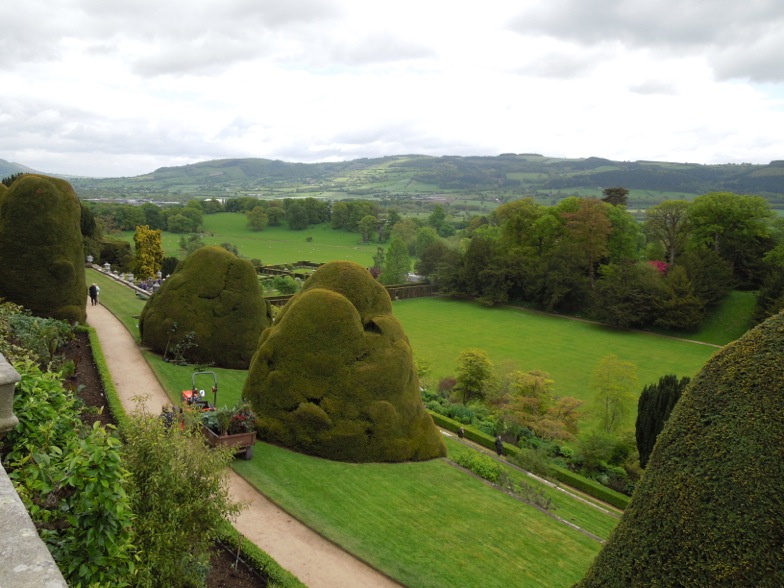
One can see why such an old fortress would be lived in for centuries -the views looking out over the surrounding Wales countryside are astounding.
And the views up towards the castle are no less impressive.
I love the way they shape all of the Yews -many dating from the 18th century which explains their size.
The last architect to work on the house in the early 20th century was George Bodley, primarily known as an ecclesiastic architect, who was a big proponent for a return to 14th century Gothic architecture.
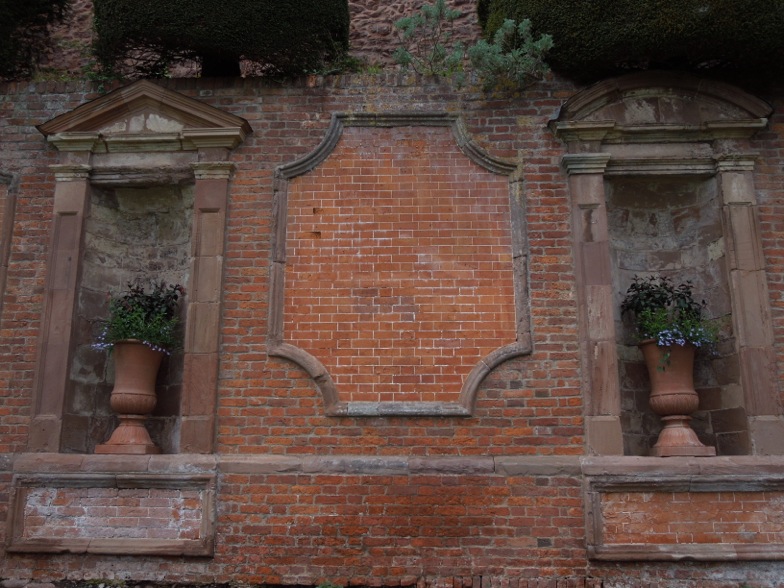
Love the potted urns in the Aedicule above. (gotta break out the big words when you know them!)
The orangery at the base of the hill leads out onto the lower garden. From this angle it looks like part of the castle, making it look like a skyscraper.
Nothing beats an English style garden in the summer in my book.

I would love to know what this big purple bush is if anyone knows?
Lovely wisteria in bloom.
The house is a treasure house as well, containing the usual 17th & 18th century masterpieces in art and furniture as well as artifacts from Bengal, India collected by the Clive family. Pictures are not allowed of these as they are still owned by the family while the house has been in the possession of the Trust since 1952.
One can stay in a large house on the grounds called the Bothy as well as another smaller cottage off the kitchen gardens.
I know this was one of Neil's favorite houses to visit in GB and suspect it would be for you as well!
Read more about Powis Castle and Garden HERE at the National Trust's website.  Worth a look at the pictures, it is super charming!