Located just west of
Rosemary Beach is the 3rd development planned by Duany Plater-Zyberk & Company,
Alys Beach.

Founded in 2003, the development is even larger than the previous projects at 158 acres which includes 20 acres of wetland preserve.

Alys Beach has an important component the other projects do not. It is designed with sustainability in mind; in particular resistance to hurricanes and strong storms. White stucco over concrete walls, strong wind-resistant windows and sheltered outdoor living spaces are all major players in the architectural vocabulary.

The architectural style is inspired by Bermuda and courtyard architecture. Alys beach is planned to be an upscale community and while far from finished, it really is impressive and feels
LUXE.

While many building sites remain, much of the infrastructure and amenities are in place.

I loved this beach pavilion with the flowing curtains overlooking the gulf.

I had a delicious latte at the Fontville Press coffee shop.

As there are wetlands, a canal of sorts runs through the project, connecting even the further-most properties to the water. This bridge connects 2 sides of the development over the canal and has this charming tower.

Along the canal are a number of really impressive houses.

This house has a rare front porch. Unlike
Seaside and
Rosemary Beach, front porches are not a requirement and most houses instead have an interior courtyard.

This house, south of 30A had an impressive front facade and a deep lot, containing a courtyard which was almost like a secret garden.

A lot of construction is happening along the waterfront with interesting houses shaping up. I loved this house with the moorish arches and shapes. Many of the construction signs were from prestigious architects such as
McAlpine Tankersley.

This beautiful house was entered through a courtyard.

These courtyard houses are a style I can get on board with as I've always been obsessed with secret gardens.

I think residents are far more likely to use private outdoor spaces such as these as opposed to the front porches of Seaside.

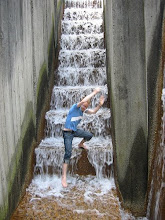
Again, water features are an important design element and you cannot get very far without hearing the tinkling of water.

My favorite portion of the development is the center portion of townhouses (I'm a devoted urbanist!)

Taking the planning from Rosemary Beach a step forward, the fronts of the houses face a common green with proper pedestrian walkways; these
FEEL like the front entrance as opposed to the small boardwalks provided at Rosemary Beach at the 'front doors'.

The white stucco is beautiful in the Florida sun and allows the different colored trim of each house to really stand out.

This was another of my favorite houses, I loved the rooftop trellis which reminded me of ancient Roman dwellings.

The alleys aren't unattractive either and have a beautiful cobblestone surface and planted trees (sad looking in winter without their leaves).

Each development seems to improve as the design team alters the things that don't work from their previous schemes and I applaud the learning process. Yes, as you can tell, even though far from complete, I think
Alys Beach is shaping up to be the best new urbanist town in Florida yet.

 Alys Beach has an important component the other projects do not. It is designed with sustainability in mind; in particular resistance to hurricanes and strong storms. White stucco over concrete walls, strong wind-resistant windows and sheltered outdoor living spaces are all major players in the architectural vocabulary.


 Named for the wild rosemary which naturally grows here, Rosemary beach was planned as an urban village in the style of a European colony. Originally planned to be about the same size as neighboring Seaside, just south of the 30A towards the beach, acreage became available during planning north of the highway which was quickly acquired and integrated into the scheme.
 Funding was easier the 2nd time around due to the success of Seaside and the popularity and market demanded a more upscale venue.
 The style is very different than Seaside, as you can see. Water features abound in the town tying you to the beach even in the heart of the village.
 The first buildings to be completed were the post office and town hall, seen above and below, which became style markers for future development.
 The center strip is quite dense, with apartments and townhouses above shops and restaurants. This isn't a sleepy little village.
 Some of the most well known houses below, which you may recognize by
  The houses along the beachfront are magnificent; more than mere seaside cottages here.
  Wood construction on masonry bases with wood porches are the requirements by the town code, which allows for a number of different styles to be used architecturally.
 I loved this house set back behind a gravel courtyard.
 This white stucco house was another of my favorites.
 These very similar houses stand out from one another by color treatments. Paint is not allowed here, rather the wood is stained. As in Seaside natural, honest materials are a requirement.
 Not everything is traditional, a good bit of the architecture has modern detailing.


 The only thing cuter than a small guest house is an adjacent matching birdhouse!
 As I've mentioned, a few weeks ago I visited
  Founded by Robert Davis on 80 acres along the Florida panhandle coastline inherited from his grandfather, the town became one of the first of many planned communities designed in "new urbanism" mode and certainly the most famous. The master plan was created by Andres Duany and Elizabeth Plater-Zyberk of the Miami firm,
  Meant to evoke the seaside resort towns of the past, Seaside was built to a prescribed scale with a set of strict guidelines to build to for those who bought into the community. And buy they did, the settlement was a successful and spawned a movement that trickled world wide to varying degrees of success and quality.
 The first part of planning was walkability. One can walk from their cottage to the beach or the commercial center, the pool, tennis courts or church in a matter of minutes. Once you arrive in Seaside, there is no need to move your car. Besides, pedestrians have the right of way and you travel faster by foot, let alone being able to find parking.
 But the town is not urban but rather a small town of low scale. Houses, no matter their style (although most subscribe to a pseudo-victorian cottage style), must have a front porch and sit a certain distance from the street. Lot sizes are small to allow for walkability and so you are forced at once into this community. Following this, the houses are true cottages and although many of the later ones push this boundary and are larger than the originals, I think it safe to say these are all very small houses.
  Even the backs of the houses are open to pedestrian alleys between streets. Many of the houses have a guest cottage which face these alleys and so if you stay one in (as I did) this is your way home. Yes, the walkway is sand as we're just a block off the beach here, as is everything.
  All properties must also be bounded by a white picket fence. According to the guidelines though, no 2 may be alike on the same street. This ensures that the community has variety within the strict guidelines. The houses were built by the lot owner rather than by a single developer and by a number of different architects, so you can imagine the variety that exists architecturally.
 The town center is still in the works, as buyers build-up their lots, but there are a number of shops and restaurants as well as the usual amenities such as bathrooms, beach changing rooms, chuch, town hall and even a post office seen above (the most photographed building in Seaside).
  I loved this modern building on the main town square. Like all of the buildings in the center of town, there is commercial space on the ground level with offices or apartments above.
 Behind the town center is a charter school which makes the resort town feel alive year round. The panhandle, as I found out, is very different than Southern Florida; they have winter! This is a seasonal resort (think late spring through fall) and though the weather was warmer than in DC, lets just say I wasn't spending much time on the beach.
 Scenic coastal highway 30A separates the town from the beach by a short block which is naturally filled with the most impressive houses.
 The road sits 2 rows of houses back from the beach with one of the pedestrian alleys between. These houses follow a different planning guideline and because of the additional pedestrian traffic are more private than houses above the highway. Many are designed in a post modern Greek-revival style differing from the houses north of 30A.
 I hope you will join me as I explore this town through a series of posts with my many many pictures and that you enjoy it half as much as I did!


 Posts
Posts







.JPG)